Wednesday, November 01, 2006

Nautical Nonsense for Halloween

Our second annual Halloween Party was a success this year. At least I think so, and I've gotten good feedback so far.

As usual we had a few games planned, some for kids and some for adults. The main kid-friendly game was the treasure hunt. Since it was a nautically themed party, this was a supposed pirate treasure hidden somewhere on the property. We came up with a few clues to lead participating guests on a merry chase through the fields (in the dark, with only two flashlights). We tried not to be too stingy with the treasure, either: we put actual cash in there along with an assortment of costume jewelry. Since the treasure chest and the key were hidden separately (ah, gotta love movie inspiration), the finders of each ended up splitting the treasure.

Other entertainments included a surprising amount of renaissance dancing (not expected, but definitely welcome), rubber duck races, and a game of fishing for bottles. The bottle fishing was the brutal adult game, since we were talking mini-bottles, and you had to empty the one you caught before you could cast for another. I had to recover for about an hour after that one.
We also had a costume contest with a lot of interesting costumes. A few pirates, of course; the goddess Thetis; the 13th Warrior (who changed costumes to a pirate later); the figurehead of a ship; an island; an aquarium; and a sailor. The island got the prize.

Good food and drink always help make a party, so we included contests for them as well. My Captain Jack won best drink, since no one else entered anything, but we had several entries in the food contest.

We're looking forward to an "Animated Characters" themed party for next year.

Wednesday, October 25, 2006

Movie Review: Beowulf & Grendel

Well, we watched Beowulf & Grendel last night, and I was not impressed. It didn’t completely suck, but it was neither “authentic” nor terribly clever.

A better title might have been the “The Vengeance of Poor Misunderstood Grendel Upon the Redneck Danes”. Seriously, the Danes and Geats act like a bunch of rednecks constantly dropping the F-word in Scottish accents. At least the rednecks are smart enough to wear their helmets when they go into a fight.

Grendel is vaguely like an adolescent taking revenge for a legitimate wrong. He lacks the supernatural invulnerability that helped define Grendel in the poem. He's just big, strong, and cunning in a neanderthalish kind of way. He's obviously meant to be a sympathetic character, and quite frankly kicks the butts of Beowulf and everyone else he fights. He pwnez Beowulf and company so bad that he actually has to cut his own arm off so it can get nailed to the wall.

And then there’s the witch Selma, played by Sarah Polley, who helps the story by dropping hints about her friend Grendel’s motivations in an undisguised American accent.

Add in a disposable subplot involving a Christian missionary and a gratuitous visit from Grendel's mother, and you've got something resembling a story that doesn't very much resemble the classic Beowulf.

I’d give this two out of five stars, I guess. Don’t rush to the video store.

Tuesday, October 24, 2006

Random Musings

Home refurbishing is finally nearing completion. Every piece of tile for the floor has been cut, only about six need to be actually laid in place, and at least half of the floor is already grouted. The final steps should be done in the next couple of days. I’m looking forward to having nights and weekends again.

Speaking of weekends, our annual Halloween party is coming up. I will try to remember to take more pictures this year. Owing to the gratuitous emptiness of the house (due to the floor replacement), we should have plenty of room to bring the festivities indoors for the most part.

Beowulf & Grendel has finally come out on DVD in this country. I’ve been waiting for this release for a while; I really, really hope it doesn’t suck. We may watch it tonight, so I may write a review in the next couple of days.

We’ve also managed to become addicted to Heroes over the last few weeks. Don’t let my skeptical writings fool you; I love this kind of stuff.

Tuesday, October 17, 2006

More Hollywood Antiscience

I don't want to harp too much on Hollywood's screenwriters; it's not like they have degrees in astrophysics or anything. They just want interesting plot devices for their stories, and they usually don't have the time or inclination to consult a qualified expert, even if they knew one, to see if their ideas are scientifically plausible. Consequently, they write scientifically preposterous plot devices that require great acts of suspension of disbelief from anyone with a scientific background. Now, I'm not saying that gross misrepresentations well-established laws of physics should keep you from enjoying the programs; I enjoy watching them myself. Just don't be fooled into thinking that there's a scientific clue being exercised in the writing studio, even if the show claims to be a "hard science fiction show". All that said, let's look at a couple of repetitive anti-science cliches that have come out of the TV industry.

Time Stopping

This is the supernatural ability of the character Hiro in the NBC series Heroes, as well as a plot point in Star Trek episodes like "Wink of an Eye" from the original series and "Timescape" from The Next Generation.

The plot gimmick in these shows is that time somehow stops or gets slowed tremendously for some characters while continuing normally for others. This means that you have some characters walking around and interacting normally with the environment while the rest are "frozen" by comparison.

Unfortunately, Hollywood writers never consider the consequences of someone experiencing time at a rate hundreds or thousands of times greater than others. As Mike Wong has pointed out on his website in relation to Star Trek, all kinds of things are time dependent that science fiction TV writers don't think about.

For example, the light by which we see is actually time dependent. A 100-watt lightbulb, for instance, is defined by the fact that it converts 100 joules of energy from electrical current into heat and light every second. If a hero alters time so that he's moving 1000 times faster than everyone else, then all the 100-watt bulbs he might be using to see become -- from his point of view -- 0.1-watt lightbulbs, and he's suddenly wandering about in the dark.

Interacting with the environment doesn't stop with sight, either. If you're going 1000 times faster than everyone else, you experience 1000 times as much air resistance as everyone else. From your perspective, the air might feel as thick as water (or worse). Even if your time-bending ability allowed you to move through the air normally, the friction created by your passing would create a super-heated shockwave wherever you went that would blast everyone you walked by (and you, too, when you allowed yourself to return to "normal" speed). If you exert five pounds of force to move an object, that object will actually experience five thousand pounds of force in normal time (which would be sufficient to damage many things you might want to move).

And finally, if you literally "stop time" for everything else, you can't do anything. You can't see, because no light is reaching your eyes. You can't move, because the immobile air is an impenetrable barrier. Actually stopping time would just be an exercise in sensory deprivation (until you suffocate from lack of oxygen, that is).

Sudden Evolution

Offenders in this category include the Star Trek: The Next Generation episode "Transfigurations", the Babylon 5 episode "Mind War", and the B5 TV movie River of Souls. These shows all describe an "evolutionary" change in which living beings of some alien race of the week transform in a bright flash from ordinary flesh-and-blood humanoids into "pure energy" beings who fly away into space (or do other things that only pure-energy beings could do).

To put it bluntly, such a transformation is not "evolutionary". In fact, it's the total opposite of evolution. If the general public got their understanding of the Theory of Evolution from shows like this, it's no wonder that they don't take the theory seriously. Evolution is about tiny variations that accumulate over the course of many generations, not dramatic changes in living examples of a species.

Moral of the Story

If you go to Hollywood for scientific understanding, you become the blind following the blind.

Sunday, October 15, 2006

Rapier Drill: Blade Control

You get a surprising amount of touches in SCA fencing by wrestling about your opponents blade to get your point on target while keeping your opponent's point at bay. Of course, in SCA fencing, you can't actually grab your opponent, only his or her weapon. Practicing at this sort of blade control is quite useful, and you should practice against various different opponents as the opportunity arises.

Saturday, October 14, 2006

Rapier Drill: Three Step Drill

This is a drill that originated early in my days of learning SCA fencing. Lord Edmund and Lord Ivan started me on it, and I perpetuate it. The objective is to use three standard Capo Ferro parries to deflect attacks, while using good footwork to move forward and backward.


As noted, the attacker makes a middle thrust, a low thrust, and a high thrust, advancing a step with each attack. The defender uses Capo Ferro parries four, two, and five (by our numbering system) to deflect the attacks while stepping back each time. The fencers reverse roles after each series.

Friday, October 13, 2006

Rapier Drill: Hand Parries

I've described this drill before. It's not all that unusual to find yourself fighting with a rapier in one hand and nothing in the other, and the purpose of this drill is to help you defend yourself in this situation, especially if you've been unfortunate enough to have your opponent trap your blade so you're left with nothing but your empty hand to defend yourself.

As I noted before, these are Jeet Kune Do parries applied to fencing. The actual hand motion that you use may vary.


Note that when I miss a parry, Ysabel stabs me in the throat. That's how a drill should work: if you don't execute your maneuver properly, you take a hit. The person making the thrusts should be on target every time. Incidentally, that's also why you need to have full gear to do this drill.

More to come...

Thursday, October 12, 2006

Rapier Drill: Footwork

Thanks to Rhys, we have video of drills performed at the last Glaedenfeld fencing practice that I actually managed to attend. I'll dole these out one at a time, to pad out my posting for the week.

First up, a very basic drill for new fencers, how to move around. These are the basic movements for moving forward, left, right, and backwards. The actual drill involves moving in a square: forward three steps, right three, back three, and left three. Note that the foot in the direction you're going (lead foot if moving forward, right foot if moving right, etc.) goes first. Passage steps are a separate drill.


Dammit, I need to lose some weight.

Wednesday, October 11, 2006

Experimenting with Reiki

No, I'm not actually going to conduct an experiment to determine whether Reiki actually works. I am, however, going to propose an experiment that might show whether there's something to the whole Reiki concept.

According to The International Center for Reiki Training's FAQ, "Reiki is a Japanese technique for stress reduction and relaxation that also promotes healing." More specifically, Reiki is "spiritually guided life force energy" that reduces stress, relaxes, and promotes healing.

We'll not dispute the potential to reduce stress and relax; evidence has shown that many phenomena can have these effects via the placebo effect. If someone believes in a treatment, then receiving the treatment will likely relieve stress and relax them whether there's anything to it or not.

Healing promotion should be testable, but it would require a double-blind, placebo-controlled study that's well beyond the scope of me or most of my humble readers (you are humble, aren't you?).

No, let's focus on the "Reiki is spiritually guided life force energy" part. After all, it's the part that could win a million bucks from James Randi (that could be used for charity, if you're too selfless to want it for yourself).

It seems reasonable that if this "spiritually-guided life force energy" exists, there should be some way to detect it. The spiritual sort of people who believe in Reiki will likely assert that technological efforts to detect this energy would be fruitless (since it's "spiritual"), but shouldn't competent Reiki practitioners be able to detect the energy they're "spiritually guiding".

So, what test scenarios might we devise to test whether Reiki practitioners can detect "life force energy".

Well, one possibility is to test whether they can detect a living creature inside a closed container. Place a test animal like a mouse inside a box that is made of thin material yet reasonably proof against transmitting sound or vibration. Have similar boxes that are empty. Reiki practitioners should presumably be able to identify the box containing a live animal with greater accuracy than individuals with no belief in Reiki, right?

Another possibility would be to test practitioners to determine whether they can tell if someone has recently experienced Reiki treatment. After all, someone who has recently received Reiki should be more relaxed and less stressed, and this should be evident in their "life force energy", shouldn't it? Recruit a "believer" willing to accept a Reiki treatment. At the beginning of an hour, the test Practitioner should examine the untreated patient to get a baseline feel for the patient's "life force energy". The test Practitioner will visit the patient after 15, 30, 45, and 60 minutes to determine if the patient has received treatment. A second Practitioner may actually perform a Reiki treatment on the patient during one of the intervals. The test Practitioner should be able to determine at what interval, if any, the patient received treatment, right? After all, the patient's "life force energy" will be changed by the treatment, won't it? If you can't detect such a change, how can you know that the patient needs treatment?

These are just a couple ideas that came to me pretty quickly. I'm sure that real Reiki practitioners who wanted to demonstrate just how effective and useful Reiki treatment is could come up with scenarios acceptable to the James Randi Educational Foundation and win a million dollars for themselves or their favorite charities.

What are you waiting for guys?

Monday, October 09, 2006

Uff Dah!

Everyone take a moment to remember Leif Eriksson, the first European known to have lead a successful expedition to the Americas. He reached modern Canada and named it Vinland around the year 1000. Today just happens to be Leif Eriksson Day.

Back from Vacation

Yes, the Saga has been silent for a week while my wife and I relaxed in sunny Orlando. We have returned, however, so I hope to resume my usual schedule of trying to post at least once a week.

We spent most of our week at Disney parks. We weren’t bothered much by the cost of admission; we knew about that expense up front and we knew what we’d be getting for it. The cost of finding something to eat in the parks, however, is a different matter. The cost of food in Disney parks seems to go up faster than inflation alone would explain, and it’s really starting to feel like gouging.

Case in point, the Biergarten in Epcot. It now costs well over $20 (US) per person to eat there, and that doesn’t include drinks (I think it’s just wrong to go to a German restaurant and not have a beer). What they serve hasn’t changed over the years, and for the first time, we didn’t feel like we got our money’s worth eating there. The same isn’t true for all Disney restaurants – we didn’t feel overcharged at Ohana, for instance, but that it’s no longer unusual. Our food highlight of the week wasn’t even at Disney; it was a Puerto Rican restaurant called La Garnita located at the corner of Sand Beach Road and Universal Drive in Orlando.

October is a good time to go to Disney for rides and such, though. The longest we waited to ride anything was 40 minutes for the Rock-n-Roller Coaster at MGM Studios, and that was at peak time. For most rides we waited less than 20 minutes. It’s also a good time to talk with people from around the world. I think all of Europe decided that early October was the time to go on vacation this year.

We also spent one day at Blizzard Beach, Disney’s newest water park. This was rated by the Travel Channel as the number 2 water park in the US, and it is a lot of fun. I only went down the Summit Plummet – the longest and steepest waterslide in the world (at present) – one time, though. It wasn’t bad dropping 90 feet at over 50 MPH (roughly 80 KPH), but the amount of water that went up my nose took some of the thrill out of it.

We are now officially Disneyed-out for a while, and have no long absences on our calendar until Gulf Wars XV.

Wednesday, September 27, 2006

Skeptics' Circle 44

I regret that I haven't posted very much this week, but some family medical issues have kept me preoccupied. Fortunately I prepared my entry for this week's Skeptics' Circle 44 well ahead of time. Hop on over to Salto Sobrius to read it and plenty of other skeptical goodness.

Tuesday, September 19, 2006

Pirate Drinks

Alrighty, then. I suppose I'll be makin' one more contribution to the festivities o' Talk Like a Pirate Day. As rum and drinkin' be prime elements o' the pirate life, I'll be contributin' these two suggestions to you lot o' scurvy dogs.

Captain Jack
1 part Gentleman Jack Daniels
2 parts Captain Morgan Tattoo

Pirate Port
1 shot o' Captain Morgan Tattoo in a wine glass of grape juice (red for ruby, white for tawny)

Alright then ye scurvy dogs! I've had enough o' pirate talk for the year. Off wit' ye!

Thar Be Tile On Ye Floors, Mateys!

Let that be the beginning and end of my contribution to "Talk Like a Pirate Day".

Over the weekend, we layed tile on approximately 25% of the downstairs of our house with the help of our Brother- and Sister-in-Law, two nieces, and a couple of other friends who wanted to learn the technique for when they do tile themselves (as well as just being helpful sorts). We squished grout between the tiles of about half that area. Hopefully we'll have all the essential components of the house back in their homes in the next day or so: the washer, dryer, hot water heater, and toilet are already back in service, but the refrigerator still needs to return to its place in the kitchen. My A&S projects are largely waiting for this endeavor to reach completion.

We do have some pictures, but they're not in our own camera, so embarassing pictures of me on the floor spreading mortar and laying tiles will have to wait.

Friday, September 15, 2006

An Example of a Blinded Test

A couple of weeks ago, my wife and I found some interesting bottles of wine on the closeout rack of a wine store we frequent (to digress, closeout racks are great). We found bottles of Jewel Shiraz and Jewel Syrah at a very low price. I immediately found the labeling odd, since Shiraz and Syrah are actually the same species of grape under two different names. The grape is usually called Shiraz by Australian growers, while French growers use Syrah, but both of these wines were made from grapes grown in California. Consequently, they should be exactly the same (as they were also bottled the same year, 2002), so why give them different labels.

I asked a store clerk about the labeling, and she told me that the Syrah should actually taste a little softer and richer. That sounded nonsensical to me, but why not take this opportunity to conduct a little test, especially since these bottles were marked down to very manageable prices.

We therefore bought a bottle of Shiraz and a bottle of Syrah and took them with us to the apartment of some friends of ours -- Lord William and Lady Juliana. My job would be to devise a test to see if anyone else at the table could distinguish between the Shiraz and the Syrah.

The test would be a simple “Which of these things is not like the others?” I started with four identical wine glasses. I then tied some colored thread provided by Juliana around the stems to uniquely identify each glass: gold, light blue, white, and green. Rolling a die, I randomly assigned Syrah to one of the glasses and wrote its color on a piece of paper to stick in my pocket. I poured Syrah in that glass and poured Shiraz in the other three. I made sure they were all filled to the same height and then took them to the dinner table. I provided blank sheets of paper for my three testers. Their task was to write down the thread color of the glass that held different wine from the other three. Instructions given, I left the room. Juliana's parents came by a little later, and they got pulled into the test, too, so I had a sample size of five participants.

Just by random chance, I should reasonably expect one or two of the testers (roughly 25%) to get the right glass. Three or more correctly identifying the odd glass (the Syrah) would indicate that there probably was a detectable difference between the two wines, be it flavor, aroma, color, etc.

As it turned out, no one identified the glass of Syrah correctly, which conclusively proved to me that there was no difference between the Shiraz and the Syrah (except, perhaps, that the Syrah had a classier label).

There were some flaws in this test. Given time and resources, I would have liked to make the following changes:
  • It would have been nice to have an intermediary between me and the testers so that I -- as the person pouring the wine -- would have no interaction with the people tasting it; that would make it a truly double-blind test (as it is, it's single-blind).
  • It would be nice to have more people involved in the test for statistically better results.
  • More test scenarios would be good: three glasses of Syrah and one of Shiraz, for instance.
  • I also didn’t think to ban table-talk before the test, so the comments of Juliana -- the first tester -- may have prejudiced the next two somewhat; fortunately the Juliana's parents arrived later and didn’t hear the table-talk, and I was able to forbid discussion of wine opinions before they’d written their choices.

Thursday, September 14, 2006

Make the Puppy Happy: Skeptic’s Circle 43

Every time someone believes an implausible claim or explanation without good reason, a puppy cries. Learn how to keep the puppy from crying at this week’s Skeptics’ Circle, brought to you by Ethics and Science.

Monday, September 11, 2006

Another Triumph in the Courts

I discovered an interesting bit of news today. It seems that a judge in Illinois has ruled that selling a piece of cheap jewelry -- like the Q-Ray Bracelet -- with a claim that it relieves pain is false advertising.
U.S. District Judge Morton Denlow ordered QT Inc. of Mount Prospect, Illinois, and its owner, Que Te Park, to refund more than 100,000 buyers of the bracelets -- priced up to $249.95 -- and forfeit profits of $22.6 million earned between 2000 and 2003.
That's right: even if a substantial percentage of customers claim that they actually experienced pain relief due to the placebo effect, advertising that your product actually provides some medical benefit without actual scientific evidence to support the claim is false advertising, and you can lose millions in court.

Now if people would just start suing the homeopaths and their ilk in the alternative medicine market...

The Coronation of Gunther and Kora

I had the pleasure of attending the coronation of His Royal Majesty Gunther and Kora over the weekend. This event included some additional auspicious awards, including the knighting of Sir Ulrich von Brandenburg (here's hoping I didn't mess the name up) and the entry of Lord Leon Jeronimo Suarez into the Order of the Meridien Blade.

Unlike some previous coronations, this one had a rather full schedule of activities to engage citizens who were not preoccupied with peer meetings and other coronation business. This included heavy fighting tournaments at which Their Royal Majesties each chose their armored combat champions. Her Royal Majesty has scheduled the selection of Her Rapier Champion to take place at Red Tower, I believe, and Their Majesties announced they would also be holding a tournament to select the Queen’s Yeoman at some future date.

There was a rapier tournament at this coronation, and I had the opportunity to fight a round against His Excellency, Earl Godwine. It is a pleasure to see that his attitude has changed from “I don’t fence, and I don’t like to watch fencing,” to “I fence, and I’m darn good at it, too!” His Excellency may not have perfected hand parries, yet, but he certainly isn’t lacking in accuracy, range judgement, and willingness to engage. His Excellency stabbed me in the leg and throat in rapid succession, and went on to the semi-final round of the tournament before being eliminated by the tournaments’ eventual winner, Lord Leon. As this was a double-elimination tournament, I continued to the quarter final round, where Lord Tormod dubh Gunn eliminated me (as has happened all too often in the past).

The evening’s festivities included the traditional White Rose Ball, which was held outdoors on the field used for the day’s armored fighting activities. The dancing went quite well, with no shortage of participants until the wee hours of the morning. I would like to thank Baroness Mariana for organizing the Ball as well as the musicians who performed for us and Lord Lorenzo Petrucci for teaching a couple of 15th-century Italian dances (Chirintana and Marchesana) after the scheduled dance list was complete. I will also say a special hello to Lady Vivian Vyvienne, since I always enjoy discovering a lovely new dance partner.

Alas, I will be out of the SCA loop for the next few weeks, as home repairs, family medical issues, and a planned vacation will be occupying my time.

Thursday, September 07, 2006

Skeptic Material Direct to You

Sometimes a piece of good material for a skepticism post falls right into your inbox. That’s right, someone at the last place I worked sent me a chain letter! Let’s all enjoy picking this piece of modern creduloid literature apart. When I get “advice” like this, the first thing I usually do is search the Snopes.com database to see if it’s a known urban legend. This one was easy to find.

CELL PHONE INFORMATION / share with family & print for future use..!!!

Yes, it announces in the very first line that it’s probably bunk. The “share” advice and multiple exclamation points are major giveaways.

What to do when your cell phone gets lost...

Here is something worth knowing if you have a mobile phone ....Have you ever wondered why phone companies don't seem interested in trying to prevent the theft of mobile phones? If you have ever lost, or had one stolen, and if you are on a plan, you still have to pay the plan approximately up to 24 months, and you have to buy another handset and enter into another contract. This is more revenue for the phone company.
The conspiracy theory element is very popular in chain letters, and usually BS. Service providers won’t generally require you to sign a new service contract if your phone is stolen. In fact, if you’re still under a contract, your phone may be insured against theft. If you’re not under contract, they may offer you a discount on a new phone if you sign another contract, but they probably won’t require it.

There is a simple way of making lost or stolen mobiles useless to thieves and the phone companies know about it, but keep it quiet.

To check your mobile phone's serial number, key in the following on your phone: star-hash-zero-six-hash (* # 0 6 #) and a fifteen digit code will appear on the screen. This is unique to your handset. Write it down and keep it safe.
The Snopes article shows this particular piece of the urban legend to be partially true:

Entering the sequence * # 0 6 # on your cell phone's keypad may produce a display showing a unique fifteen-digit International Mobile Equipment Identity (IMEI) string. However, this only works with phones that use the Global System Mobile Communications (GSM) standard, as these phones contain a Subscriber Identity Module (SIM) card that holds users' subscription information and phonebook information. Not all cellular phone service carriers use GSM technology, so entering the * # 0 6 # sequence will not work with every cell phone.
Returning to the chain letter…

Should your mobile phone get stolen, you can phone your service provider and give them this code. They will then be able to block your handset, so even if the thief changes the sim card, your phone will be totally useless. You probably won't get your phone back, but at least you know that whoever stole it can't use/sell it either.
Having the IMEI string, if it exists for your particular phone, might make it possible to keep a thief from registering it with another provider, but you certainly don’t need it to contact your own service provider and notify them that your phone was stolen so they can terminate its service.

If everybody did this, there would be no point in stealing mobile phones. You may want to send this to as many people with mobiles as possible.
The thief probably won’t try to register the phone with another provider and won’t get much for selling the handset, since the value of a stolen phone is the calls that could potentially be made on it before the service gets cut off. Digging the IMEI string from your phone (if it exists) is going to a lot of trouble for very little effect; the hardware simply isn’t worth that much to the thief.

What you really need to do if your phone is stolen is contact your service provider as quickly as possible to cut off service before the thief can make any calls.

No charge for directory assistance. Phone companies are charging us $1.00 or more for 411 - information calls when they don't have to. When you need to use the 411/information option, simply dial 1-800-FREE-411 or 1-800-373-3411 without incurring a charge. This is information people don't mind receiving - Pass it on. Works on home phones and cell phones.

This is actually a separate claim, addressed in a separate Snopes article. It turns out that this part is true. The service is provided by a company called Jingle Networks. There’s an automatic voice recognition system that asks for the location, type of listing, and listing name for which you want a number and then reads back the corresponding entry from its database. The only catch is that you may have to listen to an advertisement before you get the number.

Wednesday, August 30, 2006

The Great Animal Planet Disappointment

I used to watch Animal Planet quite a bit when visiting my parents or in-laws or any other acquaintances who happen to have cable. I find that now that we have cable ourselves, I’m not particularly drawn to AP, though. I’m really interested in the natural world, what animals can do, how they live, and how they evolved. That’s why the intrusion of pseudoscience into AP has cost the channel its charm.

What prompted this rant was an episode of Animal Planet’s “The Most Extreme” that I happened to catch recently. This show runs down a list of ten animals that excel in some particular feature like strength, speed, toxicity, intelligence, or such. The particular episode was a “best of the best” show, listing the examples from the top ten highest rated shows, and “most extreme senses” was apparently one of those shows. Sharks, with their electromagnetic sense, were the winner of that category on their show, I suppose.

If you’re not familiar with the format, “The Most Extreme” always tries to give you come kind of human comparison for the extreme animal’s characteristic. For example, the rhino beetle is their strength champion, and they say that to have comparable strength for their size, a human would have to be able to lift a tank. (Side note: In reality, muscle strength doesn’t scale directly with size, but that’s not what we’re here to discuss.) Then they’ll go on to give examples of actual human extremes in the same field; showing record-setting Olympic weightlifters as actual examples of strength, for instance.

Getting back to the extreme senses of sharks, they mentioned that you’d need to be able to smell a hot dog stand from across town to have a comparable sense of smell, and you need to be able to detect a nine-volt battery from some ridiculous distance to have comparable sensitivity to electromagnetic fields. Then they made the grand mistake of calling the shark’s electromagnetic sense a “sixth sense” and brought out their human example: Sonya Fitzpatrick, the Pet Psychic.

For me, all of the show’s credibility abruptly dropped through the floor at that point. I watched as she went to visit an alligator farm, where the owner had supposedly called her because one of his favorite alligators wasn’t behaving normally: less socially, whatever that means for alligators. I watched as Sonya cold read the guy, saying the alligator was telling her that the man seemed unhappy (Duh! Why else would Mr. Credulous call in a psychic?); naturally he immediately volunteered that he’d recently gone through a divorce (and in a "post-reading" statement, gushed at how surprised he was that she knew about it).

As for the alligator’s less social behavior, she asked what the man had changed about the way he treated the alligator, and he helpfully informed her that he’d changed its diet to something less expensive. Acting as though it takes psychic ability to realize that a dietary change will often result in a behavioral change, she told him to change its diet back, and we got a glowing follow up of how her advice had brought the gator back to its old self and improved the man’s life.

I, on the other hand, felt a little ill after watching her shamelessly manipulate the guy. I know AP has a whole show dedicated to this woman’s supposed psychic abilities, but I hadn’t been confronted with it before. I realize that they’re a for-profit venture and that psychic shows bring in the bucks, but I don’t think it’s worth the sacrifice of their scientific integrity. I don’t watch AP anymore; they've gone from a serious science channel to a circus act..

Tuesday, August 29, 2006

More on His Royal Majesty, Godwine

In case you heard a rumor -- yes, it's true. His Royal Majesty Godwine is now an authorized fencer in the Kingdom of Meridies. I'm not sure how much of a change in attitude this actually reflects, of course. He may never have had the intense dislike for fencing that some people claimed he had. He may have just not liked it until he tried it, and someone persuaded him to give it a go. For all I know, he may still dislike it, but he became authorized so that he would at least have an informed opinion. Whatever the case may be, I am very glad to have learned of this development.

I am informed that His Majesty will be present on the fencing field at the coronation of his successor, His Royal Highness Gunther. I am looking forward to the opportunity to go a few rounds with him at the event, and I hope a lot of other Meridien fencers will be there, as well.

Tuesday, August 22, 2006

Another Free Energy Claim

This one came up in a forum that I frequent, but the original article was in Yahoo news. An Irish company called Steorn claims to have developed a free energy technology. Now, they’re challenging the world to prove they didn’t.

DUBLIN (AFP) - An Irish company has thrown down the gauntlet to the worldwide scientific community to test a technology it has developed that it claims produces free energy.

The company, Steorn, says its discovery is based on the interaction of magnetic fields and allows the production of clean, free and constant energy -- a concept that challenges one of the basic rules of physics.


The rule in question, of course, is the thermodynamic principle of conservation of energy: no process produces more energy than it consumes. Steorn claims to have broken that rule, and such a big claim should come with equally big evidence. What evidence is Steorn providing?
Steorn issued its challenge through an advertisement in the Economist magazine this week quoting Ireland's Nobel prize-winning author George Bernard Shaw who said that "all great truths begin as blasphemies".

Sean McCarthy, Steorn's chief executive officer, said they had issued the challenge for 12 physicists to rigorously test the technology so it can be developed.

"What we have developed is a way to construct magnetic fields so that when you travel round the magnetic fields, starting and stopping at the same position, you have gained energy," McCarthy said.

"The energy isn't being converted from any other source such as the energy within the magnet. It's literally created. Once the technology operates it provides a constant stream of clean energy," he told Ireland's RTE radio.
So far I’m unimpressed. For starters, a magnet doesn’t contain energy (other than the inherent “heat” energy that all matter contains if its temperature is higher than absolute zero). A magnetic field is much like a gravitational field; an object moving through it can exchange energy with the magnet, just as an object moving through Earth’s gravitational field can exchange energy with the Earth. Spinning a coil around a magnet is a standard method of generating electricity, but you have to have some other kind of energy to spin the coil. You’re just changing one kind of energy into another, and losing some in the process due to inefficiency. McCarthy’s description doesn’t sound any different, in principle.

I doubt if physicists will rush to Steorn to test the technology based on this “challenge”. It’s up to Steorn to publish their research in some reputable scientific journals if they want scientific credibility. If they just want to make money, they should keep their discovery to themselves until it’s marketable. Instead of either of the sensible approaches, they’ve come out with a publicity stunt, which never bodes well.

Friday, August 18, 2006

Chocolate Mary

Color me slack: I didn’t get an article together in time for this week’s Skeptics’ Circle. Something turned up this morning, though, so here’s my late entry.

Yet another example of pareidolia in the news this week, this time a lump of waste chocolate that triggered someones religious sensibilities.

FOUNTAIN VALLEY, Calif. - As a chocolatier to the rich and famous, Martucci Angiano has posed with many celebrities — but on Thursday she held in her hand a figure that dazzles her more than any Hollywood star.

Workers at Angiano's gourmet chocolate company, Bodega Chocolates, discovered under a vat a 2-inch-tall column of chocolate drippings that they believe bears a striking resemblance to the Virgin Mary.
-- Article

Actually, it looks like a perched hawk to me. Naturally, religious employees at the chocolate company are idolizing the little lump of hardened goo. At least it looks like the Angianos plan to keep this blob instead of selling it on Ebay like most of the folks who “discover” such things do.

Tuesday, August 15, 2006

Scenes from Beggar's Rebellion

Rhys was good enough to bring his video camera to Beggar's Rebellion to get some shots of the activities. We had grand plans for taping drills and tourneys and a great variety of fencing action, but unfortunately their battery wasn't up to the task. It faded before we even finished warming up. Thus, we are left with just this video of Hawk and I warming up with swords and canes.


I don't think it quite lives up to the music Rhys chose. We need to do dramatic death scenes if we're going to go all Hollywood with the soundtrack.

Sunday, August 13, 2006

Victory!

Fjorleif and I went to Beggar's Rebellion this weekend, and there were a couple of fencing tournaments during the day. My good lady wife and I walked away with both of the prizes. I can claim to have had a combination of skill and luck that enabled me to win the bright, shiny new buckler with which I shall be blinding my foes and blocking their attacks, but Fjorleif freely admits that her victory was pure guile.

The tournament that she won was a "battle for the pig". Feodor placed a large plastic pig in the field, and the object of the tournament was to make off with it, either by eliminating the competition or by running fifteen feet with it without being intercepted. Fjorleif got hold of the pig and ran with it in the second round, not bothering to engage anyone in actual combat.

The other winners of the initial three rounds were Hawk and Mattheus, and the three of them squared (or, rather, triangled) off for a final free-for-all deathmatch. Both of the guys took two swords, while Fjorleif took my sword and dagger. My good lady wife again avoided combat until Hawk was good enough to kill Mattheus for her. She then played a retreating game until Hawk got impatient and rushed her. She was able to tangle up both his swords during the charge and jab him with the dagger, winning the tournament.

Let that be a lesson to you. Cleverness and treachery can easily outperform skill and talent.

Friday, August 11, 2006

Distillations of Defense

Distillations of Defense is the title I put on my first effort to extract the most useful information from an abridged version of Joseph Swetnam's 1617 book, The Schoole of the Noble and Worthy Science of Defence. I've since obtained scanned versions of the whole thing, and I'm working on transcribing it before I actually go back to pulling out the good stuff. I've gotten through much of the introductory material, where I came upon this comment from Swetnam...

"I have made this of brick and stones, as Augustus said of Rome at the first, but now Rome is built with marble: even so I would wish that some expert and learned person or other would pull down this rude begin work of mine and build it up with marble."

Well, maybe I -- a professional technical writer -- am the expert he sought. I have only a fraction of the fencing experience of Swetnam, but from grinding through his prose I can say that I know a hell of a lot more about writing than he did. In my transcribing effort so far, he has tried and failed something like five times to conclude his "Epistle to the common Reader"; he just can't seem to stop diving off into tangents. His spelling is inconsistent; his grammar is horrendous; and he has absolutely no concept of how to use punctuation. In his defense, I doubt these are unusual failings of Jacobean writers.

But I shall persevere, and hopefully I'll have a concise, coherent manual of Swetnam's fencing style by the time I finish. Excerpts will likely show up here from time-to-time as I progress.

In the meantime, please try not to write like Joseph Swetnam.

Wednesday, August 02, 2006

The Cure for Allergies?

I heard an interesting folk remedy while listening to talk radio recently. Callers to the show claimed that consuming raw local honey would reduce or eliminate allergy symptoms. The reasoning behind the claim is that honey contains a lot of pollen from local flowers that might be causing allergy symptoms, and exposure to this pollen through the honey allows the allergy sufferer to develop resistance to the pollen.

This sounded dubious to me. I figured that exposing someone to allergens in honey would just cause them to have symptoms. Allergy symptoms are just an out-of-control immune reaction; I know of no way to reduce allergic reactions through greater exposure to the allergens.

Nonetheless a quick search the internet found this claim being promoted on a lot of sites. About.com wasn't enthusiastic, but didn’t rule out the possibility either.
My husband and I decided to give the local honey a try. My husband after just a few days noticed a significant difference in the way he felt. After one day of taking a teaspoon of local honey, my allergy symptoms got worse. I even tried a second day, but I continued to feel rotten so I discontiued using the honey.
On the other hand ReallyRawHoney.com is a big promoter of the idea:
An Oklahoma allergist told a meeting of 150 beekeepers that raw honey is an effective treatment for 90 per cent of all allergies. Dr. William G. Peterson, an allergist from Ada in the 1950's, said he now has 22,000 patients across the nation who are using raw honey along with more customary medications to relieve allergy symptoms.

"It must be raw honey because raw honey contains all the pollen, dust and molds that cause 90 per cent of all allergies," he told a meeting of the Oklahoma Beekeepers Association. "What happens is that the patient builds up an immunity to pollen, dust or mold that is causing his trouble in the first place. The raw honey must "not be strained, not even through a cloth." he added. "I know the customer wants good, clear strained honey, and that's fine, but for health reasons, raw honey is what we need."
If only Dr. Peterson’s statements constituted real evidence. Unfortunately, he has only provided a wealth of anecdotes. He has lots of patients using raw honey, but they’re also taking conventional allergy medications. What’s really needed is a randomized, double-blind, placebo-controlled study to determine whether honey actually reduces allergy symptoms. Conveniently, a summary of such a study is available from PubMed.

Department of Pathology, UConn Health Center, Farmington 06030-3105, USA.

BACKGROUND: Allergic rhinoconjunctivitis is a common disorder, affecting >20% of people of all socioeconomic strata. Despite this high prevalence, relatively few sufferers seek professional medical help, presumably because of a widespread reliance on complementary remedies.

OBJECTIVE: We investigated the widely held belief among allergy-sufferers that regular ingestion of honey ameliorates the symptoms of allergic rhinoconjunctivitis.

METHODS: The study was conducted at the University of Connecticut Health Center's Lowell P. Weicker General Clinical Research Center. Thirty-six participants who complained of allergic rhinoconjunctivitis were recruited. All recruits were scratch-tested at entry for common aeroallergens. The cohort was randomly assigned to one of three groups, with one receiving locally collected, unpasteurized, unfiltered honey, the second nationally collected, filtered, and pasteurized honey, and the third, corn syrup with synthetic honey flavoring. They were asked to consume one tablespoonful a day of the honey or substitute and to follow their usual standard care for the management of their symptoms. All participants were instructed to maintain a diary tracking 10 subjective allergy symptoms, and noting the days on which their symptoms were severe enough to require their usual antiallergy medication.

RESULTS: Neither honey group experienced relief from their symptoms in excess of that seen in the placebo group.

CONCLUSIONS: This study does not confirm the widely held belief that honey relieves the symptoms of allergic rhinoconjunctivitis.

Emphasis mine.

This was a pretty small study, of course, having only 36 participants, so it’s just a preliminary result. Nonetheless, it’s a preliminary result that seems to refute claims that eating raw honey will reduce allergy symptoms. Furthermore, a number of the websites discussing the subject noted that some people actually had worse symptoms after taking raw honey (which is what I would expect if the honey actually contains something to which the person might react).

Pending further study, I’d say its reasonable to assume that eating lots of raw honey does not reduce allergy symptoms, and eating honey containing your specific allergens might actually cause an attack. Be smart: take your medication and get your honey filtered.

Tuesday, August 01, 2006

Free Plug: Ask the Vet

One of my high school classmates became a veterinarian, and she now has a radio talk show called Ask the Vet in Knoxville, TN, on WNOX on Sunday mornings starting at 10am Eastern time. The funny thing is that she told me she was tired of the veterinary practice because she'd grown weary of having to explain for the millionth time why pet owners needed to get heartworm medication. So now she answers questions for two hours straight every week, and I know from listening to talk radio that they won't all be really smart questions. Well, maybe if you get the answer to enough people at a time, the question doesn't have to be asked as often.

Anyway, if you happen to dwell in the Knoxville area or expect to be passing through on a Sunday morning, tune to 100.3 FM to pick up Tracy's show. You can also download previous shows from the archived show page.

Monday, July 31, 2006

Reunification

I went to my high school class reunion over the weekend. Those who know me can figure out which; those who can’t figure it out don’t need to know.

I had a good time talking with some old friends and shamelessly flirting with ladies that I was too shy to approach way back then. Some silliness you just have to grow out of, I guess.

I was pleasantly surprised to find that a few of my old classmates actually live near me now. I’ve already taken steps to get in touch with them and lure them down the dark path to the SCA. We’ll see how well that works.

Yes, we did take pictures. I have not looked through them to decide which are fit for public display here at the Saga. Time will tell...

Friday, July 28, 2006

Final Video Installment

Last of the batch of videos from last practice...


We're looking at making a lot more videos of various SCA activities, demonstrating practical things like drills and such. Look for new stuff next week.

Wednesday, July 26, 2006

Italian Rapier Parries

Among the other videos taken at our last practice was this demonstration of the basic parries of Ridolfo Capo Ferro, a fencing master who published an instructional manual -- Gran Simulacro dell'Arte e dell'Uso della Scherma -- in 1610.


In addition, Lady Ysable demonstrate the four basic guard positions of Camillo Agrippa: Prima, Secund, Terza, and Quarta.

Tuesday, July 25, 2006

Fencing Practice Videos

I wasn't actually present for fencing practice on Sunday, but one of our new members video recorded some of the activities, which I'm perfectly all right showing anyway. This first one shows the fighters rotating in a "bear pit", which is really a game of "king of the hill": whoever wins the duel keeps the field. This can actually get very tiring if you're having a good day.


There are a couple more videos, but this is the first time I've tried to embed a Youtube video, and I want to see how it works before I do more. Besides, releasing these slowly gives me blog material for three more days without effort. How can I resist that?

Friday, July 21, 2006

A Good Dance Practice

I had a pretty well-attended dance practice last night, with seven real students and one unfortunate eleven-year-old who got dragged along. I'm sure she didn't suffer any grievous harm from the experience, though.

As I had two brand new students, I tried to keep things simple, which usually means a lot of English Country. I'm finding New Boe Peep to be a good beginner dance, since it's about as simple an English Country Dance as you can get. From there, we proceeded to the somewhat more complicated but ubiquitous Black Nag.

Of course, there's a lot more to Renaissance dancing than English Country (which is, to be honest, outside the SCA period, anyway), so I also taught a few other styles of dance. For 15th-century Italian, we learned the easy and common Petite Riens; for 16th-century Italian, Ballo del Fiore; and from the Inns of Court, the Black Alman. Put together, these are actually a pretty good grounding in SCA dance.

I can only hope to have such a good class next month.

Haunting Evidence Indeed

As a follow-up to my earlier article on the Court TV program Haunting Evidence, the Amazing Randi reveals evidence that the show's producers are feeding information to their psychics before taping the shows. Imagine that...

Tuesday, July 18, 2006

In Search of... Atlantis

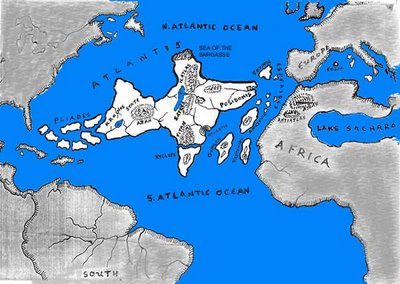
Do a web search for "Atlantis" and you'll find a lot of dubious claims about this legendary island civilization. The story of Atlantis, as most people know it, comes from the writings of the Greek philosopher Plato. According to his writings, Atlantis existed about 9,000 years before Plato himself wrote. The people of Atlantis were an advanced and prosperous civilization who grew too arrogant and were eventually destroyed by the gods. He describes their island city in some detail, describing a sophisticated canal system and multi-story buildings with indoor plumbing. The story of Atlantis was supposedly brought to Greece by another philosopher named Solon, who learned it in Egypt.


Assorted psychics and other supernaturalists have tried to attach themselves to the Atlantis legend, including Ramtha-channeler JZ Knight. They've made wild claims about the achievements of the Atlantean civilization and claimed to have located the city everywhere from the Indian Ocean to shallows of the Carribean Sea. Some have even postulated an entire continent in the middle of the Atlantic Ocean, now sunk beneath the waves. Needless to say, none of their expeditions to these places have turned up anything substantial.

You'd think with all the woo surrounding the story of Atlantis that scientists would want nothing to do with it, but scientists actually studied this story fairly seriously. They've looked for an ancient civilization that fits Plato's description and predates him, preferably located where its tragic tale might have found its way to Greece. Their search resulted the History Channel program called Lost Worlds: Atlantis, which I found myself watching a few nights ago.

Modern scientists have traced "Atlantis" to the Santorini island group which lies north of Crete. Crete itself contains ruins of the Minoan civilization, which was far more advanced than any of its Mediterranean contemporaries, at least in the field of architecture. The Minoans built a multi-story palace at Knossos on the northern coast of Crete that included earthquake-resistant reinforcements and indoor plumbing. They seem to have accomplished many of the "wonders" that Plato describes in his tale of the doomed city. The Minoan civilization fell at about the time of the Thera eruption in 1500-1600 BCE.

Thera is one of the islands in the Santorini group, but it was not the center of the eruption. Thera is just one of several islands that form a ring-shape in the Aegean sea. All of these islands, save one, are part of the rim of a volcano. The central island, Nea Kamini, is the top of the caldera of the volcano. Nea Kamini is a young island that has formed since the Thera eruption. It's quite likely, however, that a similar island existed before the Thera eruption. If "Atlantis" was on this volcanic island, then it truly would have been obliterated in the Thera eruption, since that island would have been the center of the largest volcanic explosion in human history.

Modern archaeologists did not rely on channelling the spirits of dead Atlantean citizens to locate the lost city. They did the hard work of digging out artifacts, dating them, tracing their origins, fact checking against Egyptian records, identifying new sites, digging more, and analyzing their finds to determine that the Minoans had colonized the Santorini islands in the second millenium BCE. They dug through thirty feet and more of volcanic ash and pumice to find the ruins of a Minoan city on Thera. Real science has done more to determine what truth might lie behind Plato's tale of Atlantis than any channeler, dowser, or other psychic has ever done.

If the full truth of the tale of Atlantis is ever going to be found, it's going to be found by scientists, not psychics.

A $60.00 Value for Just $19.99

How often have you heard a similar statement? This one came from a commercial for a Stick Up Bulb. Apparently they expect you to believe that they're selling a $60 product (or package of products, usually) for a third of its value.

I call cattle-excrement. If they're selling these battery-powered, portable light fixtures for $19.99, they're worth no more than $19.99. They can claim any value they like, I suppose, but the true value of something is what a buyer will pay for it, and they obviously don't expect anyone to really pay $60 for their package of two "Stick Up Bulb" light fixtures and one credit-card-sized, limited-use reading light. If they did, they'd be charging $60, not $19.99 (plus tax and shipping).

The makers of the "Stick Up Bulb" are hardly the only salesmen to use this tactic, of course. They're just the one that caught my eye when I felt the need to write an article for this week's Skeptic Circle.

Does anyone really fall for that ridiculous advertising ploy?

Friday, July 14, 2006

Irony Alert

Sometimes our President says the most amusing things.
President Bush put democracy centre-stage ahead of a big-power summit, telling beleaguered Russian rights activists on Friday he would relay their concerns to President Vladimir Putin.
--Yahoo News

Apparently when the President of Russia starts grabbing power for himself at every opportunity while the friendly Parliament acts as little more than a rubber stamp for his orders, it's a threat to democracy in the nation. Can we think of any other world leaders who are behaving similarly?

Thursday, July 06, 2006

We Definitely Live in the Country

I have two amusing pictures to share that were taken today. First, a picture of a regular visitor we get out here at the farm.


This deer has been coming around frequently to taunt our dogs. She will walk right up the fence and has even jumped the fence to lead the dogs on a merry chase around the field or, as often as not, to chase them around the field. I don't pretend to know what's going on in this animal's mind. Maybe it just amuses her. It's not like our dogs are terribly threatening. The smallest, seen in the picture, is actually the bravest of our three.

Later in the day, while I was at work, my lady wife took the following picture in our garden.


Honestly, I'm surprised my wife got close enough to take the picture. She absolutely detests things with eight legs, but she still found this big spider carrying her offspring on her back to be interesting enough to go get the camera.

And on an unrelated note. The 38th Skeptics Circle has been posted.

Wednesday, July 05, 2006

Better than Biodiesel?

My good lady wife found a website yesterday that described a simple chemical formula that you could use to fuel a diesel vehicle for just 46 cents per gallon. No, really! Here's the money quote...
DSE has developed a revolutionary method for producing an inexpensive, high performance fuel that can power ANY DIESEL ENGINE and the cost to you is only 46¢ per gallon!
The example we're using is Diesel Secret Energy, but they're not the only ones marketing such a product. Supposedly, adding a bottle of the company's compound to an appropriate amount of vegetable oil will cause a chemical reaction that produces a liquid fuel that works just as well as biodiesel at only a fraction of the cost, requiring no hazardous chemicals or costly equipment. Apart from the low cost of production, they provide additional reasons to use DSE instead of making biodiesel.
The reasons why you should NOT undertake the manufacture of Bio-diesel are apparent from the dangers of Methanol alone. Add to that the higher expense of manufacture, difficulties in obtaining and safely storing methanol and lye, and the need to dispose of the waste by-product glycerin, and you can quickly see why we make NO comparison to Bio-diesel.

In fact, the only fair comparison to Bio-diesel with our fuel is it's performance and stability. Both fuels are stable and have performance characteristics virtually identical to petroleum diesel. Both are good for the environment. Both add more lubrication to your injection pump than petroleum diesel and will decrease the need for maintenance.
And let's not forget that you can use it to make home heating oil, too.

Sound too good to be true? New Energy Report seems to think so...
A primary complaint about DSE is not even about its product. Veteran posters (and biodiesel users) to the many biodiesel forums found across the internet complain that DSE is simply selling a product that chemically thins waste vegetable oil through a process that is freely available to the public with just a minimum of internet research.
Yes, you can mix it with vegetable oil and get a fuel that will run your diesel engine for a while. Just don't use it in any engine you plan to keep very long.

This product is based on the simple fact that diesel engines are very "robust"; they'll run on just about anything that will flow through the fuel lines and burn. That's why they'll run on straight vegetable oil. They won't necessarily run very well, though, and bad fuel mixes will damage the engine, especially with prolonged use. Vegetable oil, for instance, won't actually hurt the engine while it's running, but it will gum up the parts horribly if allowed to cool in the engine. DSE appears likely to cause a different kind of damage...
The general consensus of those who are "in the know" is that DSE stands to "coke" up the fuel injectors pretty quickly, which will cause a domino effect in the engine, which could, in turn, render the engine useless.
And the safety angle?
Two of the main active ingredients in DSE were found to be xylene and naphthalene, the latter of which is commonly used in mothballs. Xylene, while less dangerous than methanol, is still a dangerous chemical, and equally stringent safety precautions should be taken while working with it.
So the classic skeptic line remains a good one: if it sounds too good to be true, it probably is.

Change in the Wind

Today marked my last day as a contract technical writer at HCA. I've known this was coming for a while, since I'm leaving of my own free will to accept a full-time position at another company, but it's still weird clearing out your desk and knowing you'll probably never go there again.

Wednesday, June 28, 2006

His Majesty Godwine and Fencing

A lot of people from the SCA have been finding their way to the Saga to get some information on His Royal Majesty, King Godwine of Meridies, because of the article I wrote about His coronation a few months ago. These visitors have come from threads on a couple of SCA message boards (the Drachenwald forums and Armour Archive forums), where His Majesty’s actions regarding fencing in Meridies are being discussed.

I’ve been hesitant to comment on this situation, because I’ve only heard second- and third-hand reports of what happened, but people who were actually involved have been describing their views on the forums, and I think both sides have now had the opportunity to present their stories. Besides, I don’t particularly like the idea of keeping my mouth shut because I’m afraid to say anything.

The controversy started when His Majesty (then still the Crown Prince) announced that there would be no Queen’s Rapier Champion during his reign. Such a choice is certainly His Majesty’s prerogative (assuming that Her Majesty is in agreement, I suppose), and this would hardly be the first reign since the creation of the award to not have a rapier champion. Nonetheless, the statement was upsetting, especially because of the way in which the news was originally passed on to the fencing community via a mailing list message from the Kingdom Rapier Marshal.
Greetings Rapier fighters of Meridies, and the others on this list. It is my sad duty to pass on to you all that their Royal Highnesses do not wish to have a Rapier Champion. Further They request that rapier not occur near them.
Perhaps His Majesty did not realize it because this is his first time as King, but when you wear a Crown on your head, all of your statements tend to be regarded as Royal Edicts. Consequently, reaction to this message from the fencing community prompted an official explanation from His Majesty, which was published on SCA Today. He said...
I am receiving news from all over the Known World that I have quashed fencing in Meridies. Let me be clear! This is not true! We will not be sponsoring fencing during our reign, and we will not have a fencing champion during our reign. I do not fence. I do not enjoy watching fencing. I have personal views on the safety of fencing and its place in the SCA as it currently performed, but these are my personal views which are not manifested in my royal prerogative. I do not wish to negatively impact fencing in Meridies.
His Majesty is not obliged to enjoy or support fencing, of course, but to say he is not going to sponsor fencing, to imply that it is unsafe, and to question its place in the SCA all in the same paragraph in which he says that he does not wish to negatively impact fencing in the Kingdom seems contradictory. The implication that fencing is not safe is particularly offensive to the fencing community and its marshals, especially since I am not aware of any evidence that fencing is less safe than any other martial activity in the SCA.

A more recent incident involving a member of the Order of the Meridian Blade has stirred even more unrest. I am not a member of the Order, so I can’t say with certainty what instructions they received from the Crown at the Order’s creation at Gulf Wars XIV. It is my understanding that the Crown instructed the original members of the Order to each found separate schools of fencing and organize them as they saw fit. Lord Ricarte Berenguer Halcon, for example, organized his school – La Gran Companiya – along the lines of a military organization, with himself as Captain and his students as privates, unit commanders, and champions. Other members of the Order had different plans, with the intent – as I understand it – to have a variety of Meridian traditions of fencing rather than adopt a particular tradition from another kingdom. I’m stating this because some posters on the message boards have said that the Order was overdue in specifying a single tradition for training and proposing new candidates, when I am not aware of them ever receiving such an instruction.

One member of the Order apparently decided to model his school after the White Scarf orders of other kingdoms, probably because he is himself a cadet to a White Scarf from Trimaris. Given the history of fencing in Meridies, the fencer might well have expected resistance from some members of the heavy fighting community and the Crown. According to message board posts, at least some people got the impression that he was trying to single-handedly force Meridies into the White Scarf Treaty. Given the context, I would have to say that using the trappings of the White Scarfs without consulting the Crown in advance was a bad idea, even though there are no specific Kingdom or Society laws against doing so.

That the Crown took offense at the fencer’s actions is not a problem. That His Majesty decided to put a stop to them is not a problem. How His Majesty chose to act on the matter is a problem, in my opinion. As I was not directly involved, I will not go into great detail: you can get information from people who were more directly involved from the linked message boards (particularly the thread at Armour Archives). The issue that bothers me is that His Majesty -- according to the KRM of the time -- held the entire fencing community hostage by threatening to ban fencing kingdom-wide in order to force an uncooperative individual to give up his fencing authorization. I have my own “personal views” as to whether such behavior is chivalrous or becoming of royalty.

I can only hope that we, as a Kingdom, can learn something from this drama. I think the Kingdom will be better off if prominent fencers think more carefully before taking such obviously provocative actions. I also think that the Crown should show more sensitivity to the feelings of its subjects in their pursuit of the Dream, whether the Crown personally enjoys those pursuits or not. I think both parties failed the Kingdom in this situation.

Saturday, June 24, 2006

Psychic Interview

Brad Guigar has a wonderful cartoon about interviewing a psychic for a staff position at Evil, Inc. I think this is how all interviews with psychics should go. Get over there and check it out.

Thursday, June 22, 2006

Skeptics' Circle 37

Autism Diva has posted the 37th Skeptics' Circle, "Live from the Bermuda Triangle". Exercise your little gray cells.

Wednesday, June 21, 2006

Advice from the Doctor

This little quote is dedicated to creationists, global warming deniers, Ann Coulter, and the Bush administration.

"The very powerful and the very stupid have one thing in common. They don't alter their views to fit the facts. They alter the facts to fit their views."

-- Doctor Who, "The Face of Evil"

The Origins Debate Goes to the Stars

Thanks to Red State Rabble for bringing this VG Cats cartoon to my attention. I don't normally read VG Cats, but I may have to start.

Wednesday, June 14, 2006

More Free Advertising for Futile Efforts

According to the Hollywood Report (via Yahoo News), Court TV is producing yet another show about psychic crime-solvers.

The premise of this spellbinding but nonetheless familiar-looking series, "Haunting Evidence," is simple: If ordinary detectives in small-town (or even big-city) America can't solve a simple murder case, then maybe Court TV can.

"Haunting" takes years-old cold murder cases and puts a new team of experts on the scene: psychic profilers, paranormal investigators and psychic mediums.

Together they solve cases that regular folk have not been able to up to this point.

It will be interesting to see how they spin the total lack of progress on these cases from psychic sources into some kind of endorsement of psychic investigators. Historically, psychics have never contributed any substantive evidence to any criminal case, despite their numerous claims (see the Wikipedia article on psychic detectives). I mean, look at their track record...

  • PsiTech reported that kidnap victim Elizabeth Smart had been killed, only to have her later found alive.
  • Psychics have been completely useless in the search for Natalee Holloway.
  • When 12 miners were inaccurately reported to have survived a West Virginia coal mine accident in January, Sylvia Browne promptly confirmed the report during a live radio interview. Unfortunately, the report was backwards; twelve miners had died.
  • Psychics couldn’t even find the lost show dog Fifi, who escaped her travel cage after the AKC Dog Show.
Psychic crime-solvers are an amusing bit of modern fantasy that the TV-viewing public takes way too seriously. In real life, they are utterly useless. This show will just be free publicity for people who are, at best, deluded or, at worst, con artists.

Tuesday, June 13, 2006

Amarone

We bottled up the Amarone on Sunday. I’m a bit apprehensive, since in preparing for the bottling I discovered that the water level in the airlock had fallen to the point that it wasn’t really locking any more. Exposure to free oxygen is bad for wine in a number of ways.

To combat the possibility of oxidation and/or bacterial action in the wine, we added sulfites before bottling. This is something we were actually going to do anyway, since the kit instructions said that the wine wouldn’t age well unless some such measures were used to help preserve it. I had a taste as we bottled, and it seems sound, but it also had that “just added sulfites” taste, so I hope that drops away soon.

We’ll be looking to start a couple more batches of wine in the next few weeks; probably a Concord-Muscadine and a Maywine.

Evil Genius

I found an amusing little computer game called Evil Genius at Big Lots over the weekend. It’s a Real-Time Strategy game with the basic premise that you’re a James Bond-style villain trying to take over the world. It appeals to my fiendish little heart, and apparently it appeals to my wife’s as well, since she’s playing it, too. Not bad for a $4.00 purchase.

Evil Genius is a product of Sierra Software, and there’s a website for the game at www.evilplanet.com. The game apparently had some problems that required a patch (which I’ve already installed), and it still has a tendency to crash; I suspect these flaws may have kept it from being a big success, but it’s so much fun that I think it deserves a sequel from Sierra with some additional features, like some customization of your villain (currently you just choose one of three) and multi-player capabilities.

Wednesday, June 07, 2006

Contrapasso on Video

As I mentioned before, Lady Francesca and I performed Contrapasso for the Kingdom Arts & Sciences competition. I was quite pleased to hear from Lord Lorenzo Petrucci the next day that he had made a video recording of the performance and put it on the internet for me to download. I've uploaded the video to a Blogger post for your viewing pleasure.

Tuesday, June 06, 2006

Insight from Judge Jones

Red State Rabble put me onto an excellent article in the Philadelphia Inquirer about Judge John Jones, who presided over the Kitzmiller vs Dover case in which he found teaching Intelligent Design as an alternative to the Theory of Evolution to be unconstitutional. There’s a certain set of the public who think that judges should make whatever ruling is most popular with the masses. To quote the judge...
If a poll shows a majority of Americans think we should teach creationism in schools, we should just go with the flow?
And the simple answer to that question is, of course, no, as the judge actually says earlier in the article...
It's a bit of a civics lesson, but it's a point that needs to be made: that judges don't act according to bias or political agenda.
I think the real lesson that certain segments of the public need to learn is a particular decision is not necessarily right just because it’s popular.

It’s not a judge’s job to please any political constituency; a judge’s job is to apply the law fairly to each case as it’s presented in the courtroom. I think the founders of this country understood the need for an independent judiciary; that’s why the Constitution requires federal judges to be appointed instead of elected.

I ask you: who is more likely to protect the rights of a minority, a politician who needs to please his electorate in order to keep his position or an appointed judge who only answers to the law itself (as interpreted by a higher judicial authority, when needed)?

That’s why we need an independent judiciary. That’s why appointed judges aren’t accountable to the person who appoints them. The fact that Judge Jones was appointed by a Conservative Christian Republican President (George W. Bush) does not mean that he must or should make rulings to please Conservative Christian Republicans: that would be unacceptable “judicial activism”. When it comes to how he makes his judicial decisions, Judge Jones doesn’t owe George Bush anything.

Another Know-it-All ID Creationist

A commenter named Christopher at Jason Rosenhouse's Evolutionblog posted a series of questions which he must surely think is devastating to the Theory of Evolution. What it really shows is a lack of understanding of the theory, a lack of serious thought about the questions, and a complete lack of imagination (since all of these questions have been answered before).
How did the gecko develop its outstanding ability to climb? Were the hairs on its toes useless up until the time they were just right? Why haven't a host of other lizards developed such a beneficial ability?
Any competent biologist could tell you that geckos evolved their ability to stick to sheer surfaces over many generations. Their “sticky hairs” that cling by van Der Waals force had some value for climbing, which became better in later generations. Other lizards don’t have this ability because they aren’t descended from the gecko ancestor in which this feature first appeared. The gecko family of reptiles is evidence for evolution, not against it.
How did the bombardier beetle slowly evolve such a dangerous mechanism without obliterating itself into extinction? If the chemicals were not just the right strength or right ingredients, or if the control valve did not close when the explosion took place, think of the consequences. If the mechanism didn't work until fully formed, think of the extra baggage it would have been.
The bombardier beetles “explosive” chemical defense isn’t really that explosive, and the basic chemicals (hydrogen peroxide and hydroquinone) aren’t all that dangerous. To paraphrase Michael Wong, the “bomb” is more like a hot fart. The chemicals that go into this defense are found in many other insects, where they serve completely different functions; the bombardier beetle family simply evolved a useful way to put them together. There are, in fact, many different species of bombardier beetle with varying degrees of sophistication in their “explosive” delivery systems. The fact that such variation in the mechanism exists blows Christopher’s “if the mechanism didn’t work fully formed” argument right out of the water.
How did the hummingbird develop into such a high-metabolic bird? Why are there not many other birds similar to it? What fossils do we have that show its gradual development into what we know them as today?
The hummingbird line of descent evolved into what they are today because of the resources they exploited and the means they used to do it. Even a light bird can’t easily feed on nectar from a flower by landing on it; very few flowers will support even that light amount of weight. Thus, those that could hover long enough to get a meal from a flower could exploit this resource more effectively, and successive generations evolved to improve their nectar-feeding abilities. And let’s not forget that many flowering plants started to evolve to take advantage of these nectar-feeding birds. As for why there aren’t many other families with similar capabilities, the answer is simple: common descent. Birds that aren’t in the “family tree” of hummingbirds won’t spontaneously display hummingbird features; again, their restriction to a particular family line is evidence for the Theory of Evolution.
How did the giraffe slowly develop such a brain structure that would allow it to raise and lower its head without any problems? If they are the result of millions of years of evolution, wherein they grew longer and longer necks overtime in order to eat from the trees, why aren't there hundreds of other animals with such necks?
Obviously, the giraffe brain structure and circulatory system were evolving at the same time that the population was growing larger and longer in the neck to exploit trees as food sources. Does Christopher think each feature of a species develops independently of the others? Again, the lack of long-necked browsers in other family lines is evidence of common descent, not design. After all, wouldn’t a designer use this nifty feature in other lines and other places?
How did male seahorses ever evolve from non-pouch to pouch? Why would they ever develop a pouch in the first place? How did the eggs survive before the male ever developed a pouch, and who convinced the male to watch over the eggs once the pouch was developed?
OK, I’ll admit it: I don't know all the answers. Seahorse reproduction does seem kind of backwards compared to that of other fish families. Of course, I would venture to say that the eggs of seahorse ancestors survived before the development of the pouch in much the same way that other fish eggs dropped in the wild survive today: numbers, location, and luck. The question of how females started dropping off eggs with the males instead of males dropping off sperm with the females is one for a biologist who actually studies seahorses, but it wouldn’t occur to Christopher to do some actual research. The fact that I don’t personally know the evolutionary answer doesn’t mean there isn’t one.
If the platypus developed from some type of rat millions of years ago, how did its fleshy snout develop into a leather bill? How did the electric sensors evolve where none existed before? And why do they lay eggs? Why don't many other mammals lay eggs?
Maybe you just meant it figuratively Christopher, but leather is chemically “tanned” flesh, and a platypus’ “bill” is not tanned: it’s a variety of fleshy nose. Electric sensors aren’t that odd in nature; many fish species also have them. Their reproductive system suggests that their line diverged from those of other mammals (like rats) early in the divergence of mammals from reptiles. “Legacy” features from long-extinct ancestors aren’t that unusual in nature; you might as well ask why whales have finger bones.
These are questions that some can imagine answers to, but such answers remain just that . . . imagination. An Englishman by the name of William Paley wrote nearly two centuries ago in his book, titled Natural Theology, that design requires a Master Designer. If someone found a pocket watch, he said, lying on the ground, he would reach the conclusion that it had been designed by a watchmaker. The order and design of the natural world, Paley reasoned, also points to the existence of an omnipotent Creator Designer.
Imagination is part of the bedrock of science, Chris. It takes imagination to develop a hypothesis for how or why anything happens. But science doesn’t stop with imagination; it requires experiments and observations to build evidence either supporting or refuting the hypothesis. The Theory of Evolution has well over a century of supporting evidence on its side, and if there were any legitimate refute, scientists would have already dropped it to look for an explanation that did fit the evidence. The demands for evidence that other scientists can examine quickly eliminate flawed hypotheses in a very evolutionary manner. Only the most accurate hypotheses survive to become theories.

As for the incredibly ancient Watchmaker argument, I’ll just link to one of the numerous online refutes of that stale old canard. It basically boils down to the following: if something is complicated it couldn’t have evolved, so it must have been designed, and we need not do any further investigating.

Monday, June 05, 2006

X-Men 3

My wife and I went to see X-Men 3 last Thursday. I would have posted about it earlier, but preparations for the Kingdom Arts & Sciences and Royal University of Meridies event prevented me from getting to the blog until after the weekend.

Let me start off by saying that X3 is an entertaining movie that’s well worth seeing. That said, X3 is a noticeable step down in quality from the two previous installments. There is at least one noticeable deviation in character development from the previous two films, and this movie has continuity problems of a sort not seen in its predecessors. I blame these issues primarily on the change in directors; I just don’t think that Brett Ratner “gets” X-Men the way that Bryan Singer did. Singer left the X3 project to direct Superman Returns, which I’m not even all that interested in seeing (based on the previews so far).

Before I get into real spoilers, I’ll also highlight a problem that Scott Kurtz brought up in regard to X2. Do the writers of these movies just not like the character of Cyclops? His role was small in X1, negligible in X2, and it’s practically non-existent in X3. He’s an important character in the comics: why is he such an afterthought in the movies?

And another non-spoiler question: what was the point of bringing Juggernaut into this movie? In the comics, he’s not even a mutant, and he really has no place in either of the movie’s main plots.

For my opinions with spoilers, look in the Comments.

KA&S / RUM

The combined Kingdom Arts & Sciences and Royal University of Meridies event took place over the weekend in Americus, Georgia, on the campus of Georgia Southwest University. While some people have issues with sites where classes and activities are spread over a fairly large area (at least four different buildings at this event), I really didn’t find that it bothered me.

Lady Francesca and I entered the performing arts category of the A&S competition with Contrapasso, an Italian dance published in 1581 by Fabritio Caroso. I know there were some video cameras trained on the stage during the competition, so I’ll have to see if I can get clip of us performing the dance and host it somewhere. Contrapasso is a dance for an unspecified number of couples, and dancers get to interact with each other quite a bit during the dance. Caroso described the dance we did last year, Laccio d’Amore, as an “encounter”, which we took to be a sort of “first meeting” in our interpretation. We danced Contrapasso as a “courtly love” expression between two people who have a romantic interest that they can’t really pursue except on the dance floor. That should give a few gossips something to drone on about.

We scored 18 out of 20 this year, which is just about as good as we could have expected to score. We lost one point on difficulty, which is better than I expected, since Contrapasso really isn’t a terribly difficult dance, and I couldn’t increase the difficulty without learning Italian and doing the translation myself. We also lost one point on artistry for not being dressed appropriately for the period: Francesca and I both wore modern shoes. I guess the quest for period footwear will have to begin if we want to get that last point.

Mistress Miramah asked those of us who taught RUM classes (I taught Contrapasso and Ballo del Fiore for a 16th century Italian dance class) to write an opinion of how combining RUM with KA&S worked. I didn’t manage to get it to her at the event, so I’ll share it with the world (in addition to emailing her a copy).

While combining the A&S competition event (KA&S) with the A&S teaching and learning event (RUM) sounds good in principle, I don’t think it works very well logistically, especially for those of us involved in the performing arts. RUM needs experienced teachers, but the A&S competition ties up many potential teachers in performances and/or judging. Consequently, the dance class schedule at this event was pretty light; I don’t know how classes for other performing arts were affected. Furthermore, a lot of the performing arts entrants will miss the chance to attend RUM classes that they would like to take because of conflicts with the performing arts competition schedule. Where someone (like me) chooses to both teach a class and enter the competition, the combined event creates a further scheduling headache for the event organizers, who need to somehow reconcile potential conflicts between the class schedule and the performance schedule.

If attendance or a shortage of calendar dates is driving the desire to combine RUM with KA&S, my good Lady wife Fjorleif suggested that combining RUM or KA&S with some other event that was less likely to create conflicts might be more feasible. For instance, she suggested that either event might generate fewer logistical issues if combined with the Kingdom Fighters’ Collegium. I’m not sure whether that would be a good solution, but it is certainly another possible experiment.