You may not be familiar with the term “shipping” as used in this context. In internet fandom, shipping refers to a serious interest in the development of a romantic relationship between two fictional characters. In the case of J. K. Rowling’s Harry Potter novels, for instance, there have been two major shipper groups: the Harry-Hermione shippers and the Ron-Hermione shippers. At this point, I’ll note that a spoiler for the novels is coming up, so if you haven’t already read Harry Potter and the Half-Blood Prince, you may want to stop reading now.
Moving on, shipper “cults” can become pretty invested in seeing a particular relationship develop. Some become so invested that they can become hostile to an author if the particular relationship they’ve been hoping to see never materializes. J. K. Rowling was reportedly surprised by the reaction of some Harry-Hermione shippers when she revealed in Harry Potter and the Half-Blood Prince that the Harry-Hermione romance was never going to happen. Some of her fans became angry and claimed they were going to return their copies of the book, get rid of all their other related books, and stop following the series altogether.
So what does this have to do with science and the Bible? Well, I suspect that a certain faction of the religious have always expected that scientific discoveries would vindicate their Biblical beliefs. As an example, the so-called “Theory” of Intelligent Design was the latest effort to create a solid relationship between God and science. ID would show that while the scientific evidence of an ancient Earth and the slow development of various species from a common ancestor was accurate, the whole process would never have worked without the hand of God intervening and managing the process all the time.
Unfortunately, ID failed to do anything of the sort. It turned out to be nothing more than another collection of dubious criticisms of the Theory of Evolution, some poorly conceived mathematical arguments, and a big Argument from Ignorance. The failure of ID to produce any convincing evidence is part of a long record of unsuccessful efforts to find scientific support for Biblical claims.
And so it seems that as another Science-Bible shipper cult dies a gruesome death in cases like the Kitzmiller vs Dover suit, devoted followers of the cult are turning against the side they believe failed in the relationship. Naturally, most see science as the side that let them down. Right now, virtually any scientific claim – be it climate change, pollution, shrinking oil supplies, etc. – is subject to dismissal by religious fundamentalists who believe that science has rejected them.
If the religious would just stop looking for scientific validation of their beliefs, they'd probably be a lot happier.
Wednesday, March 28, 2007

Monday, March 26, 2007
Where there are Knights, there will be Knaves
I'm just passing on a bit of disappointing news from Gulf Wars XVI.
Greetings all,
Gulf Wars XVI was great, and later I may write up a nice post on the good times, but unfortunately, my first post must be about the really bad experience...
Sunday morning we discovered that someone had stolen most of our gear that I had left by our pavilion space Saturday evening at the battlefield. I should not have left it there overnight, however, we had left plenty of armor, weapons, etc. there during the week without incident. I have been in the SCA for over 25 years now, and, blissfully ignorant, have never had anything stolen before.
Whoever did this stole a goodly number of items of no small monetary value, probably more than a thousand dollars of stuff (in replacement value). But of more import, they stole from me an innocence, an ideal, a feeling of comfort and security. Now, when I take the field at the next foreign war, I will know that someone on that field may be a thief, a low, base, vile, dishonorable varlet.
Now I will know that all my opponents and even my allies may not be honorable men and women of valor.
This was unfortunately not a case of mistakenly gleaned items, but of theft. Our very large weapon pile was picked over, the thieves left a couple of weapons they did not want. Crispin's armor bag was turned into Lost and Found, but the helmet and gauntlets had been removed from it and it was found at a different location than it was left. At least one other person also had her helmet and gauntlets stolen in a similar manner.
Please forward this email on to every SCA list that might prove helpful. The far corners of the Knowne Worlde should know these items are stolen. Maybe someone will notice someone coming home from the war with a bounty of new used weapons and armor. Maybe the theives will give themselves away somehow and justice can be served (a police report has been filed).
All told, there were 5 fiberglass spears, 5 glaives/pole arms, 2 great swords, 2 long swords, 2 chairs, 1 pavilion, 1 helmet and 1 pair gauntlets stolen from us.
Spear: Nine foot long Black fiberglass shaft (older, thicker-walled variety of shaft) covered in wood grained contact paper; self-made thrusting tip, tapered, no shield hook; large knob end on the handle with black grip tape.
Spear: Nine foot long Brown fiberglass shaft (newer variety of shaft, very light) covered in very tattered wood grained contact paper; Mandrake Armory thrusting tip kit with shield hook; small knob end on the handle with black grip tape.
Spear: Nine foot long black duct taped shaft with decorative white
crosses; self-made cylindrical thrusting tip; the spear was a few inches too
long and did not pass inspection.
Spear: Nine foot long black and purple decorated shaft; self-made thrusting tip (tapered) with a decorative yellow fleur-de-lis on the thrusting tip's face.
Spear: Nine foot long red fiberglass shaft, un-taped, cracked slightly; self-made thrusting tip and shield hook.
War Glaive: Rattan 7 1/2 foot long shaft, has a unique bend to it with shaved sides; grip tape handle and grip at top of the haft; self-made thrusting tip and butt spike; self made flat teardrop shaped hand guard at the juncture of haft and blade.
Short Glaive: Six foot long shaft, blade silver and blue duct tape, haft covered with black duct tape and spiral wrapped with grip tape; thrusting tip and butt spike self-made using black rubber ball hitch covers; flat oblong hand guard at juncture of haft and blade.
Glaive: Apx. seven foot rattan shaft, stained to look like a darker wood; silver duct tape blade with black contrast edge.
Glaive: Apx. Seven and a half foot long rattan shaft; silver duct tape blade with black contrast edge; two large, red taped, busted-ass thrusting tips on either end.
Great Sword: Apx. six foot rattan greatsword, light and strong; shaved handle, silver duct tape with black tape contrast edge.
Great Sword: Apx. six foot rattan greatsword, light and strong; shaved handle, silver duct tape with black tape contrast edge.
Field Pavilion: "First Up" brand 10x10 popup pavilion, blue canopy, white metal frame; black triangular dagging sewn around bottom edge of canopy; patches with Tymm Gard's and the Triskele Legion's devices sewn over the "First Up" logos on the canopy.
Gauntlets: Mild steel mitten gauntlets; Blacksword Armory design and make; they were painted black with white letters drawn upon them.
Helmet: Mild steel bascinet with bar grille; Blacksword Armory original item. I will post links to pictures of the missing items later...
Swords: Inch and a quarter diameter rattan, shaved handles; Asgard black plastic cup hilts; silver duct tape with yellow contrast edges; no thrusting tips.
Chair: Wooden framed, short legged "Director's" style; beige mesh waterproof fabric back and seat; sold at Target stores.
Chair: Dark wooden folding chair, period design with a carved back piece and lion head carved into the ends of the arm rests. This chair is fairly unique and not readily replacable.
Please forward any info to Anushka at aleannain_AT_insightbb_DOT_com
Greetings all,
Gulf Wars XVI was great, and later I may write up a nice post on the good times, but unfortunately, my first post must be about the really bad experience...
Sunday morning we discovered that someone had stolen most of our gear that I had left by our pavilion space Saturday evening at the battlefield. I should not have left it there overnight, however, we had left plenty of armor, weapons, etc. there during the week without incident. I have been in the SCA for over 25 years now, and, blissfully ignorant, have never had anything stolen before.
Whoever did this stole a goodly number of items of no small monetary value, probably more than a thousand dollars of stuff (in replacement value). But of more import, they stole from me an innocence, an ideal, a feeling of comfort and security. Now, when I take the field at the next foreign war, I will know that someone on that field may be a thief, a low, base, vile, dishonorable varlet.
Now I will know that all my opponents and even my allies may not be honorable men and women of valor.
This was unfortunately not a case of mistakenly gleaned items, but of theft. Our very large weapon pile was picked over, the thieves left a couple of weapons they did not want. Crispin's armor bag was turned into Lost and Found, but the helmet and gauntlets had been removed from it and it was found at a different location than it was left. At least one other person also had her helmet and gauntlets stolen in a similar manner.
Please forward this email on to every SCA list that might prove helpful. The far corners of the Knowne Worlde should know these items are stolen. Maybe someone will notice someone coming home from the war with a bounty of new used weapons and armor. Maybe the theives will give themselves away somehow and justice can be served (a police report has been filed).
All told, there were 5 fiberglass spears, 5 glaives/pole arms, 2 great swords, 2 long swords, 2 chairs, 1 pavilion, 1 helmet and 1 pair gauntlets stolen from us.
Spear: Nine foot long Black fiberglass shaft (older, thicker-walled variety of shaft) covered in wood grained contact paper; self-made thrusting tip, tapered, no shield hook; large knob end on the handle with black grip tape.
Spear: Nine foot long Brown fiberglass shaft (newer variety of shaft, very light) covered in very tattered wood grained contact paper; Mandrake Armory thrusting tip kit with shield hook; small knob end on the handle with black grip tape.
Spear: Nine foot long black duct taped shaft with decorative white
crosses; self-made cylindrical thrusting tip; the spear was a few inches too
long and did not pass inspection.
Spear: Nine foot long black and purple decorated shaft; self-made thrusting tip (tapered) with a decorative yellow fleur-de-lis on the thrusting tip's face.
Spear: Nine foot long red fiberglass shaft, un-taped, cracked slightly; self-made thrusting tip and shield hook.
War Glaive: Rattan 7 1/2 foot long shaft, has a unique bend to it with shaved sides; grip tape handle and grip at top of the haft; self-made thrusting tip and butt spike; self made flat teardrop shaped hand guard at the juncture of haft and blade.
Short Glaive: Six foot long shaft, blade silver and blue duct tape, haft covered with black duct tape and spiral wrapped with grip tape; thrusting tip and butt spike self-made using black rubber ball hitch covers; flat oblong hand guard at juncture of haft and blade.
Glaive: Apx. seven foot rattan shaft, stained to look like a darker wood; silver duct tape blade with black contrast edge.
Glaive: Apx. Seven and a half foot long rattan shaft; silver duct tape blade with black contrast edge; two large, red taped, busted-ass thrusting tips on either end.
Great Sword: Apx. six foot rattan greatsword, light and strong; shaved handle, silver duct tape with black tape contrast edge.
Great Sword: Apx. six foot rattan greatsword, light and strong; shaved handle, silver duct tape with black tape contrast edge.
Field Pavilion: "First Up" brand 10x10 popup pavilion, blue canopy, white metal frame; black triangular dagging sewn around bottom edge of canopy; patches with Tymm Gard's and the Triskele Legion's devices sewn over the "First Up" logos on the canopy.
Gauntlets: Mild steel mitten gauntlets; Blacksword Armory design and make; they were painted black with white letters drawn upon them.
Helmet: Mild steel bascinet with bar grille; Blacksword Armory original item. I will post links to pictures of the missing items later...
Swords: Inch and a quarter diameter rattan, shaved handles; Asgard black plastic cup hilts; silver duct tape with yellow contrast edges; no thrusting tips.
Chair: Wooden framed, short legged "Director's" style; beige mesh waterproof fabric back and seat; sold at Target stores.
Chair: Dark wooden folding chair, period design with a carved back piece and lion head carved into the ends of the arm rests. This chair is fairly unique and not readily replacable.
Please forward any info to Anushka at aleannain_AT_insightbb_DOT_com
Tuesday, March 20, 2007
Back from Gulf Wars 16
Well, I’m back from Gulf Wars XVI and I’ve had a day to recover, so I can finally post something about it. The bad news is that I was a complete camera slacker, so I’ll have to prevail on some other people to provide pictures for me at some point.
Dance activities went pretty well at the war, and I think I’ve got a better handle on how to do things for next year. Among other things, I’ve got a good idea of what days and times are best for dance classes, and I know that putting classes on the schedule definitely does help with attendance. I'll be starting a new mailing list for dance hosts and instructors soon to plan the next war's activities better. On a related note, Lady Francesca and I won the Populace Prize for performing arts.
Since I was coordinating dance activities, I didn’t spend as much time fencing this year as I have in previous years. I participated in the Verona Street Brawls on Monday and got to spar some with the Queen of Ansteorra; I must say it’s always a pleasure to have royalty come out to join us on the rapier field. I didn’t armor up again until Thursday for the Ladies of the Rose tournament, in which I didn’t last long (which is becoming a distressing pattern – I need to practice more). Helped hold one of the flags for a while in the Ravine Battle, despite our major numerical disadvantage, and I fought in the Field Battle, as well. Numbers were killing us in the war point battles, though.
My final bit of fencing fun was the Fort Battles on Saturday afternoon. These aren’t worth war points, which makes them far more relaxed and fun. We had even teams, which generally does not bode well for the invaders. In fact, I was rather surprised when our side successfully invaded the fort on one of our turns attacking. Capitan Ricarte Bereguer Halcon came up with the idea of just ignoring the windows and the sally port and rushing everyone through the main gate immediately. This proved to be a bit of a surprise for the defenders and we took the fort with surprisingly few casualties. That was the only time the attackers won.
Now I just have to scrounge around and see if I can scare up some pictures.
Dance activities went pretty well at the war, and I think I’ve got a better handle on how to do things for next year. Among other things, I’ve got a good idea of what days and times are best for dance classes, and I know that putting classes on the schedule definitely does help with attendance. I'll be starting a new mailing list for dance hosts and instructors soon to plan the next war's activities better. On a related note, Lady Francesca and I won the Populace Prize for performing arts.
Since I was coordinating dance activities, I didn’t spend as much time fencing this year as I have in previous years. I participated in the Verona Street Brawls on Monday and got to spar some with the Queen of Ansteorra; I must say it’s always a pleasure to have royalty come out to join us on the rapier field. I didn’t armor up again until Thursday for the Ladies of the Rose tournament, in which I didn’t last long (which is becoming a distressing pattern – I need to practice more). Helped hold one of the flags for a while in the Ravine Battle, despite our major numerical disadvantage, and I fought in the Field Battle, as well. Numbers were killing us in the war point battles, though.
My final bit of fencing fun was the Fort Battles on Saturday afternoon. These aren’t worth war points, which makes them far more relaxed and fun. We had even teams, which generally does not bode well for the invaders. In fact, I was rather surprised when our side successfully invaded the fort on one of our turns attacking. Capitan Ricarte Bereguer Halcon came up with the idea of just ignoring the windows and the sally port and rushing everyone through the main gate immediately. This proved to be a bit of a surprise for the defenders and we took the fort with surprisingly few casualties. That was the only time the attackers won.
Now I just have to scrounge around and see if I can scare up some pictures.
Wednesday, March 07, 2007
Anatomy of a Dance Reconstruction, Part 5
Chained walk done in the wheel.For this chained walk, the dancers are “swimming” around the circle by exchanging hands in what English Country Dances would call a “hey”.
Each man will take the right hand of his lady, and they will do together 1 Seguito grave with the left; then taking the hand of the other lady by the left, they will do another Seguito with the right; and so they will follow from hand to hand, doing always the chain in the wheel, until they will have done 6 Seguiti: to the end of which each one will be discovered again in his place with his lady: and they will do this in 3 times of the Sonata.
The seguito grave is normally three steps in three counts, followed by a pause on the fourth count. According to Caroso, it will take six seguiti gravi to complete a journey around the circle and return to your partner. This section of the music has forty-eight ordinary beats, so one seguito grave is going to have to use eight of them.
This is going to be one of the trickiest parts of the dance to interpret. In Contrapasso, this portion of the music takes eight seguito ordinario, so using the same arrangement of the music to complete six seguito grave could be problematic. The Dragonscale Consort arrangement of Contrapasso in Due the music may be incompatible with Contrapasso Nuovo.
After that they will do together the Riverenza grave, and 2 Continenze,The riverenza grave will take twelve beats, and the continenze six beats left and six right.
with 4 Seguiti flanked, 2 back, and 2 forward.This is the same set of flanked seguiti ordinario that we saw during this movement of the music before. As before, the sequence will take twenty-four ordinary beats.
All together will do 2 Passi gravi, and 1 Doppio presto forward, starting with the left, and they will take hands in the wheel,As before, each passo grave will take three ordinary beats and the seguito ordinario will take six.
then back they will do 2 Passi grave, and 2 Riprese to the right, starting with the right.Each passo grave will take three beats and each riprese will also take three.
Letting go of hands then, they will do of new the said 4 Seguiti flanked, as of above.Four more flanked seguito ordinario in twenty-four beats.
Finally each man will take the right hand of his lady, and doing the Riverenza with the left foot; and each one turning the body to the lady which will stand to the left hand, they will take her left hand, and will do the Riverenza with the right:A riverenza grave to your partner and another riverenza to your contrary (the person standing to the opposite side of you from your partner), each taking twelve beats.
then all letting go will do 4 Seguiti flanked, 2 back, and 2 forward, scurrying, starting it with the right:Four more flanked seguito ordinario in twenty-four beats.
finally they will end the Ballo with doing the Riverenza with the left foot, which they will be found to have forward.And a final riverenza.
| Beats | Steps |
| 48 | 6 Seguiti gravi, exchanging hands around the set, starting with your partner |
| 24 | Riverenza grave, and 2 Continenze |
| 24 | 4 Seguiti ordinarii, 2 flanked back, and 2 forward |
| 12 | 2 Passi gravi, and 1 Doppio presto forward |
| 12 | 2 Passi grave, and 2 Riprese to the right |
| 24 | 4 Seguiti ordinarii, 2 flanked back, and 2 forward |
| 12 | Riverenza gravi to partner |
| 12 | Riverenza gravi to contrary |
| 24 | 4 Seguiti ordinarii, 2 flanked back, and 2 forward |
| * | Riverenza grave |
On to Part 6.
Science in the Media
I came across this photo and caption on Yahoo News.


Liu Shuping, a farmer specializing in raising pigs, presents a newly-born piglet with one head, two mouths, two noses and three eyes, for photographers in Xi'an, northwest China's Shannxi Province March 6, 2007. Experts attributed it's condition to genetic variation, local media reported. Picture taken March 6, 2007. CHINA OUT REUTERS/China Daily (CHINA)Despite the opinion of some unnamed “expert”, this little pig does not have a genetic variation. This is a developmental error, not a genetic error. Specifically, we’re looking at a small-scale manifestation of conjoined twins. Makes you wonder who the China Daily considers an expert.
Friday, March 02, 2007
Anatomy of a Dance Reconstruction, Part 4
We have now reached the first change of the music. I generally think of this second movement of the music as a sort of chorus, although it’s certainly not one in the same sense as the chorus of a cascarda like Laccio d’Amore or Gracca Amoroso. It has a repetitiveness, though, that makes me think of it that way. This movement of the music is where the dancers start to really interact with each other.
The passi gravi still take three beats each, but the seguito semidoppio is a trickier step to perform in the allotted six beats of music. The two passi presti together should theoretically take three beats, with the seguito spezzato taking the remaining three, but you may find it hard to stretch two quick steps over three beats of music. Just how to make the rhythm look and feel natural is something to work out when you actually start performing the steps to the music. My guess is that I’ll arrange the passi presti in two beats, the spezzato in the next three, and rest briefly on the sixth beat. This part of the change will take another twelve counts.
In the third set of exchanges, we take the other person by both hands instead of just one. This could potentially be a little awkward when switching in the middle. Again, the switches will take twenty-four beats, followed by flanking out and back for twenty four beats.
Summing all that up…
In our next installment, we’ll go back to the first movement of the music, as the entire piece essentially repeats in full, but with movements for the dancers.
On to Part 5.
After each one will take the right hand of his lady, and will do 2 Passi gravi, with 1 Seguito ordinario, starting it with the left, and changing place.Going by our previous timing cues, each passo grave will take three (ordinary) beats and the seguito ordinario will take six. First time around, the lords will switch places with their partners while holding right hands. This will take twelve counts
Then the man taking the left hand of the lady which he will find to the right hand, they will do together 2 Passi gravi, and 1 Seguito semidoppio, changing place always: they will not be sorry, if the second turn they will be found without their lady, because then to the end of the third change, each one will be discovered again with his own.Here’s where this dance differs most interestingly from Contrapasso. Instead of the partners reversing their turn to go back to their original places, they separate and start working their way around the circle. They take the left hand of the next lord/lady in the circle to do a second switch.By the third repeat of the “chorus”, they’ll find each other again.
The passi gravi still take three beats each, but the seguito semidoppio is a trickier step to perform in the allotted six beats of music. The two passi presti together should theoretically take three beats, with the seguito spezzato taking the remaining three, but you may find it hard to stretch two quick steps over three beats of music. Just how to make the rhythm look and feel natural is something to work out when you actually start performing the steps to the music. My guess is that I’ll arrange the passi presti in two beats, the spezzato in the next three, and rest briefly on the sixth beat. This part of the change will take another twelve counts.
The Semidoppio done, they will do 4 Seguiti ordinarii, 2 flanked back, and 2 forward.A similar set of flanked seguiti ordinarii occurs in Contrapasso. This entire sequence will take twenty-four ordinary beats. I suspect that everyone will need to make these moves toward the outside of the circle to avoid collisions.
Second change.The exchanges now continue, the only difference being that the we “arm” our way around instead of just taking hands. By arming, we meant that you lightly hold the other person by the elbow. The switches will take twenty-four beats, followed by flanking out and back for another twenty four beats.
The men will take the lady who stands to the right hand by the right arm, and they will do the same which they will have done in the first change when they took her by the hands, always changing ladies, and place.
Third change.
The men taking the lady which stands to the right by both hands, they will do the same changes said above. And to the end of this change each one will be discovered again at his place, as they were standing when they started the Ballo.
In the third set of exchanges, we take the other person by both hands instead of just one. This could potentially be a little awkward when switching in the middle. Again, the switches will take twenty-four beats, followed by flanking out and back for twenty four beats.
Summing all that up…
| Beats | Steps |
| 12 | 2 Passi gravi, and 1 Seguito ordinario (hands) |
| 12 | 2 Passi gravi, and 1 Seguito semidoppio (hands) |
| 24 | 4 Seguiti ordinarii, 2 flanked back, and 2 forward |
| 12 | 2 Passi gravi, and 1 Seguito ordinario (arms) |
| 12 | 2 Passi gravi, and 1 Seguito semidoppio (arms) |
| 24 | 4 Seguiti ordinarii, 2 flanked back, and 2 forward |
| 12 | 2 Passi gravi, and 1 Seguito ordinario (both hands) |
| 12 | 2 Passi gravi, and 1 Seguito semidoppio (both hands) |
| 24 | 4 Seguiti ordinarii, 2 flanked back, and 2 forward |
In our next installment, we’ll go back to the first movement of the music, as the entire piece essentially repeats in full, but with movements for the dancers.
On to Part 5.
Monday, February 26, 2007
Born Free?
My brother- and sister- in- law treat us well when we visit. That usually includes complete breakfasts in the mornings. Such breakfasts often include eggs. I'm going somewhere; wait for it.
My sister-in-law purchased some rather special eggs which were served when we last visited. All-natural, vegetarian-fed eggs under the brand name "Born Free" in fact. It's a very impressive label. You might even get the impression that they were from free-range chickens. If you got that impression, you'd be wrong.
Here's the basic label. Note that it says "Born Free" in very large characters.

Note also that it says "from caged hens" in rather small, white characters on a very light background.

Let me emphasize that for you if you're having trouble reading it.

Despite being called "Born Free", these are not free ranged chickens. The eggs come from "caged hens". While you might be interested in eggs from chickens fed an all-vegetarian diet (and my good lady wife points out that feeding hens corn is actually typical), you wouldn't want to buy these eggs on the assumption that they're coming from free-range chickens.
Have we learned to read the fine print, now?
My sister-in-law purchased some rather special eggs which were served when we last visited. All-natural, vegetarian-fed eggs under the brand name "Born Free" in fact. It's a very impressive label. You might even get the impression that they were from free-range chickens. If you got that impression, you'd be wrong.
Here's the basic label. Note that it says "Born Free" in very large characters.

Note also that it says "from caged hens" in rather small, white characters on a very light background.

Let me emphasize that for you if you're having trouble reading it.

Despite being called "Born Free", these are not free ranged chickens. The eggs come from "caged hens". While you might be interested in eggs from chickens fed an all-vegetarian diet (and my good lady wife points out that feeding hens corn is actually typical), you wouldn't want to buy these eggs on the assumption that they're coming from free-range chickens.
Have we learned to read the fine print, now?
Wednesday, February 21, 2007
Anatomy of a Dance Reconstruction, Part 3
In our last entry, we defined the steps that we would be using in this dance.
With those sorted out, we can now try to make them fit the music (you can download a brief sample from the Dragonscale Consort's album page). Of course, one of the first things that you’ll notice when listening to the music is that it isn’t arranged in measures of eight or sixteen counts. It’s arranged in measures of twelve or twenty-four counts. Consequently, a step that usually takes four beats will take six beats in this particular dance.
Again, we’ll want to work with just a manageable portion of the text, so we’ll go with the introductory portion of the dance.
Next, we have two ordinary sequences, which are ornamented doubles. An ordinario normally takes four counts, so in this dance they will take six. Since an ordinario consists for four steps, we’ll have to figure out a way to space them out over six beats. For me, that usually means taking the steps in the first four beats and then resting on the last two.
Unfortunately, at no point have we actually determined which dancers are going in which direction while “walking in the wheel”. Having no visual reference for how the dance was performed in period, this will be a matter of interpretation, which we’ll examine in a future post.
On to Part 4.
| Step | Description |
| Continenze | Move the left foot four inches away from the right, then close, including a smooth dipping motion. A continenza takes four counts. |
| Doppio presto | A double with rising and lowering of the heels, done in two counts. |
| Passi grave | Single steps that take two beats each |
| Passi presti | Single steps that take one beat each |
| Riprese | From feet even, move the left foot 4 inches away from the right, raising both the heels a little; then close, lower both heals. A ripresa, takes two counts. |
| Riverenze grave | For the riverenza grave, draw your left foot back in a straight line until the toe is even with your right heel, then bend and widen at the knees to descend. Rise by straightening at the knees while bringing your left foot forward until it’s even with your right. The whole motion takes eight counts. |
| Seguito grave | Three passi in three counts, followed by a pause on the fourth count. |
| Seguito ordinario | Move the left foot forward so the heel is even with the right toe; advance the right foot similarly in the second beat; the left advances again in the third beat, and the right falls even on the fourth. This is essentially a double in four counts. |
| Seguito semidoppio | Two passi presti and one seguito spezzato. The whole sequence takes four counts. |
| Seguito spezzato | Place the left foot a half step forward; in the second beat, place the right toe next to the left heel and raise both heels, then settle. |
| Trabuchetti gravi | From a standing start with your feet even, hop a little to your left, leaving all your weight on your left foot and keeping your right foot up. Then hop back to your right, landing on your right foot and keeping your left up. Be careful not to let one foot slip behind the other during the trabuchetti; both feet should remain even from a front-to-back perspective. All of this takes place in two counts. |
With those sorted out, we can now try to make them fit the music (you can download a brief sample from the Dragonscale Consort's album page). Of course, one of the first things that you’ll notice when listening to the music is that it isn’t arranged in measures of eight or sixteen counts. It’s arranged in measures of twelve or twenty-four counts. Consequently, a step that usually takes four beats will take six beats in this particular dance.
Again, we’ll want to work with just a manageable portion of the text, so we’ll go with the introductory portion of the dance.
To do this Contrapasso, 6 people will befall you, 3 men, and 3 ladies; the which will stand in the wheel with this order, that is, 1 man and 1 woman,We begin with our starting positions. We have three couples arranged “in the wheel”, but we’re left wondering what Caroso means by a wheel. It’s undoubtedly some kind of circular arrangement, but we don’t really have enough information to know whether everyone’s facing inward, or the couples are facing around clockwise, or what. We’ll have to see what follows to determine the details.
and all without taking hands will do together the Riverenza grave,This is our first actual movement direction. The couples are not holding hands. They all perform a Riverenza grave, which we learned in the last post would normally take eight ordinary beats. For this dance, then, the move will take twelve ordinary beats.
and 2 Seguiti ordinarii turned to the left:
Next, we have two ordinary sequences, which are ornamented doubles. An ordinario normally takes four counts, so in this dance they will take six. Since an ordinario consists for four steps, we’ll have to figure out a way to space them out over six beats. For me, that usually means taking the steps in the first four beats and then resting on the last two.
and walking in the wheel, moreover to the left, they will do 2 Passi gravi, and 1 Seguito semidoppio;Passi gravi typically take two beats each, so these will take three beats each. The seguito semidoppio normally takes four beats, so it will take six in this dance: three beats for the initial two passi presti and three more for the spezzato.
then turning back facing, with finding them in the manner which they were standing in the start, they will do 2 Passi gravi and 3Two more passi gravi will take another six counts, and three trabuchetti will take another six.
Trabuchetti, starting it with the right and concluding to feet even.
They will return to do the same walk another turn.And at this point we repeat everything we’ve already done except the opening Riverenza, which has nothing to do with us walking in the wheel.
| Beats | Steps |
| 12 | Riverenza grave |
| 12 | 2 Seguito Ordinario (doubles) |
| 6 | 2 Passi Grave (slow singles) |
| 6 | 2 Seguito semidoppio (two quick singles and a spezzato) |
| 6 | 2 Passi Grave (slow singles) |
| 6 | 3 Trabuchetti (one hop to each foot per trabuchetto) |
| 36 | Repeat from Seguiti Ordinarii |
Unfortunately, at no point have we actually determined which dancers are going in which direction while “walking in the wheel”. Having no visual reference for how the dance was performed in period, this will be a matter of interpretation, which we’ll examine in a future post.
On to Part 4.
Monday, February 19, 2007
Anatomy of a Dance Reconstruction, Part 2
If you're just joining us, you may want to read Part 1 before proceeding.
For dance reconstruction purposes, we needn’t bother with the facsimile and transcription of the dance right away; we’re primarily interested in the translation. The other pieces are only important if we want to include them in A&S documentation.
With the translation in hand, we’ll want to start trying to match the steps to the rhythm of the music, so we’ll look at the first paragraph of description.To do this Contrapasso, 6 people will befall you, 3 men, and 3 ladies; the which will stand in the wheel with this order, that is, 1 man and 1 woman, and all without taking hands will do together the Riverenza grave, and 2 Seguiti ordinarii turned to the left: and walking in the wheel, moreover to the left, they will do 2 Passi gravi, and 1 Seguito semidoppio; then turning back facing, with finding them in the manner which they were standing in the start, they will do 2 Passi gravi and 3 Trabuchetti, starting it with the right and concluding to feet even. They will return to do the same walk another turn.Immediately, we start to encounter a good bit of dance jargon. Unless we know what the author means by Riverenza grave and Seguiti ordinarii, we’re not going to get very far. Caroso describes the common steps used in his dances separately from the dances themselves, so at this point we need to start looking up the definitions of the steps used in this dance. Rather than do them all in detail, we’ll take a look at his description of the Riverenza grave. The description is quite verbose, but it contains various important bits of information, so we’ll break it into manageable chunks.
The Riverenza grave is done keeping the body and the legs well straight, with the middle of the left foot most in front of the right, and 4 inches distant from it, being careful that the points of both feet stand well straight.The opening statement provides a general description of our starting position. We stand up straight, feet slightly apart, left foot leading some, and toes pointed forward.
And because in the major part of the Balletti happen 8 perfect beats of music, which are 16 ordinary beats;This may seem innocuous, but it’s actually pretty useful to know. Not all of Caroso’s dances have this timing, so you need to be ready to adapt. In fact, we’ll be doing it in this very dance.
but have to know that in the first 4 beats begin and finish all the Riverenza: and in the last four, the 2 Continenze, as I will say to you later.Caroso has left us with a bit of a quandary, here. When he says that the Riverenza takes 4 beats, he doesn’t say whether he means “perfect” beats or “ordinary” beats (this is the sort of oversight that offends me as a technical writer). When the time comes, we simply have to figure out which way works to the music. Having heard the music, I can say with assurance that, in this case, he means “perfect” beats.
The first time, stand in perspective with the left foot forward, as was said, and with your facing turned towards that of the lady: and not as it is done by others, who keep turned towards the bystanders, who stand opposite: in that manner it seems that they despise the lady with whom they wish to dance: and that here with each effect whom they owe always to revere and to honor:Bow to your partner, not to the audience. It should be clear that any bow you make to the audience is not part of the dance. In the first of our four perfect beats, your left foot should be in front of you.
In the second, draw back the left foot in a straight line, until the point of this is even with the right heel: keeping it level on the floor, and not elevating the heel: be careful in the drawing back the foot, of bowing a little with the head, and the body, accompanying this act with what grace which would better favor it, and having both the knees well extended.In the second of the four perfect beats, you draw your left foot back until your toe is even with your right heel, keeping your foot flat on the floor. Incline your head slightly at this point.
The third, one owes to diminish down the legs together with the body, widening the knees some with beautiful grace.In the third beat, bend at the knees to lower your body.
The fourth and final, one must advance it, returning the left foot to even with the right, and raising the body and the head togetherIn the fourth beat, rise back up, straighten your head, and bring your feet even.
We have started the Riverenza with the left foot, because the pattern of revering of the body of the heart; and also because the constancy, and stability of our body is the right foot: the which must not move ever before we have done the Riverenza, nor less in the dance. Be careful now, which each act, or movement in the start of the Balli always must be done with the left foot.This particular statement gives useful guidance for all step reconstructions; it tells us that the opening moves of all of Caroso’s dances (and 16th century Italian dances in general) will begin with the left foot.
Nor do I wish to let go of to say, which of the many ways this Riverenza will be diversely done, forsomuch as that some people finding themselves with feet even at the start, draw the left foot back flaking instead of in a straight line, and standing with the legs straight and with the point of said foot on the ground: others, drawing a little back, cross it around the right: others, drawing it purely back, rest with the point of that behind the heel of the right: and others pulling it turn their body, and keeping with the point behind on the ground: the which manners all, because they are extremely clumsy and foul, have resolved to note for caution everyone to avoid this, and to shun them.Here Caroso notes that there are many variations on the performance of the Riverenza, although he doesn’t approve of them. From this we might conclude that we shouldn’t panic if we don’t perform the step exactly as he teaches, nor should we be surprised if we find another 16th century dance master (like Cesare Negri) describing a step differently from Caroso. Putting all these details together, we have four “perfect” beats or eight “ordinary” beats to complete the Riverenza grave. From a standing position with our feet slightly apart and toes pointed forward, we do the following…
- Extend the left foot forward slightly.
- Draw the left foot back until its toe is even with the right heel, keeping the foot flat on the floor. Also, incline the head slightly.
- Bend at the knees to lower the body.
- Rise back up, straightening the head, and bringing the feet even.
Remember that you are showing reverence to your partner, not to the audience.
I will leave it as an exercise for the reader to reconstruct the other steps used in the dance, including the Seguito ordinario, Passo grave, Seguito semidoppio, Trabuchetto, Seguito grave, Continenze, Doppio presto, and Riprese.
Continue to Part 3.
Friday, February 16, 2007
Too Damn Cute
I used to have a dachsund that would have been perfect for this...
In unrelated news, Skeptics' Circle 54 is up.
In unrelated news, Skeptics' Circle 54 is up.
Monday, February 12, 2007
Anatomy of a Dance Reconstruction, Part 1
I have no idea whether anyone would be interested in how I go about such things, but I figured I might as well do a post on how I personally go about researching a Renaissance dance for reconstruction.
Step one, of course, is to settle upon a dance to reconstruct. I typically start by looking through my collection of recorded music, since the music is essential to both the reconstruction and performance of the dance. I’m looking for three features at this stage:
Contrapasso has been researched before, both by myself and others, but I’ve yet to see Contrapasso Nuovo on a dance list anywhere, so it fulfills criterion #2.
Finally, the entire text of Il Ballarino is available on the internet in facsimile, transcription, and translation. Easy access to source material is a huge bonus, especially if you want to demonstrate your process to an internet audience. This dance easily meets criterion #3.
This concludes the first stage of dance reconstruction -- choosing the dance. I’m going to stop here for the moment, since I plan to milk this topic for at least three posts.
The process continues in Part 2.
Step one, of course, is to settle upon a dance to reconstruct. I typically start by looking through my collection of recorded music, since the music is essential to both the reconstruction and performance of the dance. I’m looking for three features at this stage:
- I like the music,
- the dance isn’t commonly performed in my kingdom, and
- a period description of the dance is readily available.
Contrapasso has been researched before, both by myself and others, but I’ve yet to see Contrapasso Nuovo on a dance list anywhere, so it fulfills criterion #2.
Finally, the entire text of Il Ballarino is available on the internet in facsimile, transcription, and translation. Easy access to source material is a huge bonus, especially if you want to demonstrate your process to an internet audience. This dance easily meets criterion #3.
This concludes the first stage of dance reconstruction -- choosing the dance. I’m going to stop here for the moment, since I plan to milk this topic for at least three posts.
The process continues in Part 2.
Friday, February 09, 2007
Amber Hnefatafl Pieces
Aardvarchaeology has posted an article about some amber game pieces uncovered at a boat grave dig in Sweden. His find leads to an interesting hypothesis about the people who played hnefatafl in 9th-10th century Sweden.
Tuesday, February 06, 2007
Pewter Casting Resources
I had a comment from "Rhiannon" that asked...
Hi there, I've been trying to find out how/where to learn to cast pewter, in the high hope of casting a set of pieces for a game a little like chess, only with dragons and mages.
Would you be able to tell me how you learned (or perhaps give me some pointers)?
I can't seem to find her comment anywhere in the blog anymore, but I did get the email notification in late January, so for anyone else who might be wondering, I found an article about Pewter Casting in Soapstone Molds on the internet.
Hi there, I've been trying to find out how/where to learn to cast pewter, in the high hope of casting a set of pieces for a game a little like chess, only with dragons and mages.
Would you be able to tell me how you learned (or perhaps give me some pointers)?
I can't seem to find her comment anywhere in the blog anymore, but I did get the email notification in late January, so for anyone else who might be wondering, I found an article about Pewter Casting in Soapstone Molds on the internet.
Monday, February 05, 2007
Fear the French!
There can be no greater terror...
...than a French Dalek!
On an unrelated note, I did have a good time at Saltare. I'm hoping to get some video from Rhys to make a good post about it.
...than a French Dalek!
On an unrelated note, I did have a good time at Saltare. I'm hoping to get some video from Rhys to make a good post about it.
Thursday, February 01, 2007
Monday, January 29, 2007
Shooting Yourself in the Foot
I don't want Muslims to think I'm deliberately busting on them in this post. I'm not singling them out, it's just that they're the ones who made the news most recently. Fundamentalists of other stripes also engage in similar acts of self-endangerment in the name of religion (the Amish and Jehova's Witnesses being notable American religious groups with medical taboos).
EDIT: My bad. I had the Amish confused with the Quakers when I first wrote the post. The Quakers are innocent of anti-vaccination hysteria.
In a Times article mentioned on the SD.net BBS, I heard that a fundamentalist Muslim doctor is advising Muslims not to let their children receive vaccinations for common childhood diseases.
The inevitable result of such claims, of course, is that the number vaccinated people in the targeted groups will decline, which will lead to a resurgence of easily preventable illnesses. Furthermore, the resurgence won't just be limited to the segments of the population that avoid vaccination. Since no vaccine is 100% effective for all recipients, the small percentage for whom the vaccine didn't "take" will be at greater risk of running into a carrier from whom to get the disease. The groups who subscribe to anti-vaccine propaganda will suffer the most, but they'll bring the infection rate up a little bit for everyone else, too.
Admittedly, there probably are "haram" ingredients in vaccines. Does that mean you're just supposed to ignore them and let Allah decide whether your child gets polio, measles, or mumps? Or do you use the vaccine and ask forgiveness? Allah does forgive, doesn't he? I don't know if there's an unforgiveable sin in Islam, but Dr Shuja Shafi, a spokesman for the health and medical committee of the Muslim Council of Britain, doesn't seem to think this would be one.
EDIT: My bad. I had the Amish confused with the Quakers when I first wrote the post. The Quakers are innocent of anti-vaccination hysteria.
In a Times article mentioned on the SD.net BBS, I heard that a fundamentalist Muslim doctor is advising Muslims not to let their children receive vaccinations for common childhood diseases.
Dr Abdul Majid Katme, head of the Islamic Medical Association, is telling Muslims that almost all vaccines contain products derived from animal and human tissue, which make them “haram”, or unlawful for Muslims to take. Islam permits only the consumption of halal products, where the animal has had its throat cut and bled to death while God’s name is invoked.It's not like the world needs more anti-vaccination hysteria. Various fringe groups have emerged in recent years with conspiracy theories about vaccines being deliberately tainted to cause infertility or negligently laced with heavy metals (used as preservatives). Such claims generally don't require evidence to convince the crowds they're aimed toward, either. Among conspiracy theory crowds, lack of evidence is considered proof of a cover up.
The inevitable result of such claims, of course, is that the number vaccinated people in the targeted groups will decline, which will lead to a resurgence of easily preventable illnesses. Furthermore, the resurgence won't just be limited to the segments of the population that avoid vaccination. Since no vaccine is 100% effective for all recipients, the small percentage for whom the vaccine didn't "take" will be at greater risk of running into a carrier from whom to get the disease. The groups who subscribe to anti-vaccine propaganda will suffer the most, but they'll bring the infection rate up a little bit for everyone else, too.
Admittedly, there probably are "haram" ingredients in vaccines. Does that mean you're just supposed to ignore them and let Allah decide whether your child gets polio, measles, or mumps? Or do you use the vaccine and ask forgiveness? Allah does forgive, doesn't he? I don't know if there's an unforgiveable sin in Islam, but Dr Shuja Shafi, a spokesman for the health and medical committee of the Muslim Council of Britain, doesn't seem to think this would be one.
In terms of ingredients in vaccines, there are so many things that are probably haram, but in the absence of an alternative we are allowed to take it for the sake of our health.
Tuesday, January 23, 2007
Saltare Approaches
Yes, I’ve been a blog slacker for over a week. In my defense, I’ve been rather busy helping organize this year’s Saltare dance event as well as coordinating dance activities for Gulf Wars.
Saltare 2007 will be taking place on February 3rd in the student center of the University of Alabama at Huntsville, with some activities in the nearby Tom Bevill Center.
Saltare 2007 will be taking place on February 3rd in the student center of the University of Alabama at Huntsville, with some activities in the nearby Tom Bevill Center.
Friday, January 12, 2007
How Bill Gates Went Broke
I have to share this email from a very dear friend of mine who I can only hope sent it to me as a joke; the name is being withheld to protect the (hopefully) innocent. According to Snopes, variations of this particular gag have been bouncing from mailbox to mailbox since 1997. This is the “Bill Gates wants to go broke” incarnation. We’ll go through it bit-by-bit to look at all the tell-tale signs of an email hoax.
THIS TOOK TWO PAGES OF THE TUESDAY USA TODAY - IT IS FOR REAL
Lots of capitalized text is a good indicator of nonsense, since apparently ANYTHING IS MORE BELIEVABLE IF YOU TYPE IT IN ALL CAPS.
To all of my friends, I do not usually forward messages,
Of course, that line was presumably written by the instigator of the chain, so they’re technically not forwarding the message. They just expect millions of other gullible people to do it for them.
But this is from my friend Pearlas Sandborn and she really is an attorney. If she says that this will work - It will work. After all,What have you got to lose?
The old “what have you got to lose?” line is a favorite in chain letters. After all, what’s the risk of losing the good will of all the friends in your email address book compared to the negligible possibility that Bill Gates is giving away billions of dollars for no good reason.
SORRY EVERYBODY.. JUST HAD TO TAKE THE CHANCE!!! I'm an attorney, And I know the law. This thing is for real. Rest assured AOL and Intel will follow through with their promises for fear of facing a multimillion-dollar class action suit similar to the one filed by PepsiCo against General Electric not too long ago.
I don’t remember any such lawsuit; do you? It must have happened, though. Even though I should remember a multi-million dollar lawsuit fought between two of the world’s largest corporations, surely a LAWYER wouldn’t be making this up! I mean, her friend used her name in the letter and everything!
Dear Friends: Please do not take this for a junk letter
Perish the thought! I’m really starting to believe this, people. The author of this letter is INCREDIBLY PERSUASIVE.
Bill Gates sharing his fortune. If you ignore this, You will repent later.
Important messages like this always make major grammar errors, like leaving the verbs out of sentences. These messages are so important, you just HAVE to send them right away, without running a spelling/grammar check or anything.
I also like the quasi-Biblical threat (since no one uses "repent" in normal communications).
Microsoft and AOL are now the largest Internet companies and in an effort to make sure that Internet Explorer remains the most widely used program, Microsoft and AOL are running an e-mail beta test.
Obviously, the best way to insure the continued success of a WEB BROWSER is to run a massive EMAIL beta test that throws away money.
When you forward this e-mail to friends, Microsoft can and will track it (If you are a Microsoft Windows user) For a two weeks time period. For every person that you forward this e-mail to, Microsoft will pay you $245.00 For every person that you sent it to that forwards it on, Microsoft will pay you $243.00 and for every third person that receives it, You will be paid $241.00. Within two weeks, Microsoft will contact you for your address and then send you a check.
Absolutely TRUE! And Microsoft also uses this technology to track down terrorists and turn them in to the government. That’s how we caught Osama Bin Laden and utterly destroyed Al-Qaeda! Oh, wait…
Regards. Charles S Bailey General Manager Field Operations
1-800-842-2332 Ext. 1085 or 904-1085 or RNX 292-1085
This is unquestionably a real person with a real title, and I have no doubt those numbers are legit.
Thought this was a scam myself, But two weeks after receiving this e-mail and forwarding it on. Microsoft contacted me for my address and within days, I received a check for $24, 800.00. You need to respond before the beta testing is over. If anyone can affoard this, Bill gates is the man. It's all marketing expense to him. Please forward this to as many people as possible. You are bound to get at least $10, 000.00
Let me try doing a little math, here. The version of this that I got was apparently forwarded four times. The number of “To” addresses in the forwards varied from twelve to thirty-five. If we’re conservative and guess that the average victim forwards this to ten acquaintances, that’s over 2.6 million dollars in advertising expenses in just four chain links. If this conservative chain continued one link per day for the two weeks this promotion is supposedly running, Bill and company would need to pay out over 2.3 QUINTILLION dollars (2.3 million billion or $2,320,000,000,000,000)! That’s over 46 thousand times what Microsoft earns in a year (before expenses). It’s also about 900 times the 2006 budget of the United States.
Are we seeing the nonsense, yet?
We're not going to help them out with their e-mail beta test without getting a little something for our time. My brother's girlfriend got in on this a few months ago. When I went to visit him for the Baylor/UT game, she showed me her check. It was for the sum of $4,324.44 and was stamped "Paid In Full".
And just for some added internal inconsistency, we have this conundrum (which actually reiterates a problem I skipped over earlier in the letter). What good is it for us to forward this email – which is part of a TWO WEEK beta test – if some guy's girlfriend got into it and got paid MONTHS ago? Supposedly you get paid a couple of weeks after you forward the letter, meaning THE PROMOTION IS OVER BEFORE ANYONE GETS PAID. If people have already gotten paid, there is absolutely NO CHANCE that you will get any renumeration for forwarding this email, even if it weren't a hoax from the start.
Can we stop forwarding nonsense like this now?
THIS TOOK TWO PAGES OF THE TUESDAY USA TODAY - IT IS FOR REAL
Lots of capitalized text is a good indicator of nonsense, since apparently ANYTHING IS MORE BELIEVABLE IF YOU TYPE IT IN ALL CAPS.
To all of my friends, I do not usually forward messages,
Of course, that line was presumably written by the instigator of the chain, so they’re technically not forwarding the message. They just expect millions of other gullible people to do it for them.
But this is from my friend Pearlas Sandborn and she really is an attorney. If she says that this will work - It will work. After all,What have you got to lose?
The old “what have you got to lose?” line is a favorite in chain letters. After all, what’s the risk of losing the good will of all the friends in your email address book compared to the negligible possibility that Bill Gates is giving away billions of dollars for no good reason.
SORRY EVERYBODY.. JUST HAD TO TAKE THE CHANCE!!! I'm an attorney, And I know the law. This thing is for real. Rest assured AOL and Intel will follow through with their promises for fear of facing a multimillion-dollar class action suit similar to the one filed by PepsiCo against General Electric not too long ago.
I don’t remember any such lawsuit; do you? It must have happened, though. Even though I should remember a multi-million dollar lawsuit fought between two of the world’s largest corporations, surely a LAWYER wouldn’t be making this up! I mean, her friend used her name in the letter and everything!
Dear Friends: Please do not take this for a junk letter
Perish the thought! I’m really starting to believe this, people. The author of this letter is INCREDIBLY PERSUASIVE.
Bill Gates sharing his fortune. If you ignore this, You will repent later.
Important messages like this always make major grammar errors, like leaving the verbs out of sentences. These messages are so important, you just HAVE to send them right away, without running a spelling/grammar check or anything.
I also like the quasi-Biblical threat (since no one uses "repent" in normal communications).
Microsoft and AOL are now the largest Internet companies and in an effort to make sure that Internet Explorer remains the most widely used program, Microsoft and AOL are running an e-mail beta test.
Obviously, the best way to insure the continued success of a WEB BROWSER is to run a massive EMAIL beta test that throws away money.
When you forward this e-mail to friends, Microsoft can and will track it (If you are a Microsoft Windows user) For a two weeks time period. For every person that you forward this e-mail to, Microsoft will pay you $245.00 For every person that you sent it to that forwards it on, Microsoft will pay you $243.00 and for every third person that receives it, You will be paid $241.00. Within two weeks, Microsoft will contact you for your address and then send you a check.
Absolutely TRUE! And Microsoft also uses this technology to track down terrorists and turn them in to the government. That’s how we caught Osama Bin Laden and utterly destroyed Al-Qaeda! Oh, wait…
Regards. Charles S Bailey General Manager Field Operations
1-800-842-2332 Ext. 1085 or 904-1085 or RNX 292-1085
This is unquestionably a real person with a real title, and I have no doubt those numbers are legit.
Thought this was a scam myself, But two weeks after receiving this e-mail and forwarding it on. Microsoft contacted me for my address and within days, I received a check for $24, 800.00. You need to respond before the beta testing is over. If anyone can affoard this, Bill gates is the man. It's all marketing expense to him. Please forward this to as many people as possible. You are bound to get at least $10, 000.00
Let me try doing a little math, here. The version of this that I got was apparently forwarded four times. The number of “To” addresses in the forwards varied from twelve to thirty-five. If we’re conservative and guess that the average victim forwards this to ten acquaintances, that’s over 2.6 million dollars in advertising expenses in just four chain links. If this conservative chain continued one link per day for the two weeks this promotion is supposedly running, Bill and company would need to pay out over 2.3 QUINTILLION dollars (2.3 million billion or $2,320,000,000,000,000)! That’s over 46 thousand times what Microsoft earns in a year (before expenses). It’s also about 900 times the 2006 budget of the United States.
Are we seeing the nonsense, yet?
We're not going to help them out with their e-mail beta test without getting a little something for our time. My brother's girlfriend got in on this a few months ago. When I went to visit him for the Baylor/UT game, she showed me her check. It was for the sum of $4,324.44 and was stamped "Paid In Full".
And just for some added internal inconsistency, we have this conundrum (which actually reiterates a problem I skipped over earlier in the letter). What good is it for us to forward this email – which is part of a TWO WEEK beta test – if some guy's girlfriend got into it and got paid MONTHS ago? Supposedly you get paid a couple of weeks after you forward the letter, meaning THE PROMOTION IS OVER BEFORE ANYONE GETS PAID. If people have already gotten paid, there is absolutely NO CHANCE that you will get any renumeration for forwarding this email, even if it weren't a hoax from the start.
Can we stop forwarding nonsense like this now?
Wednesday, January 10, 2007
ID vs Evo: The Game
Actor Kirk Cameron (of Left Behind fame) and Christian author Ray Comfort have produced a board game called Intelligent Design versus Evolution, available from Living Waters. Unsurprisingly, they market it as “a board game that reveals the insanity of perhaps the greatest hoax of our times -- the unscientific ‘theory of evolution.’”
I won’t delve deeply into the hubris of an actor and author who really know nothing about the subject thinking they’re going to bring down one of the best-supported theories in modern science with a board game. I don’t have the game, nor do I intend to spend money to get a copy, so I don’t know exactly what ID/Creationism arguments they use on the game cards (although history suggests there won’t be anything that hasn’t already been repeatedly refuted by people who actually understand the Theory of Evolution).
What I will present is a small introduction to selective quoting by Creationists. I first learned about this game when it became a topic on Mike Wong’s bulletin board. Mike’s BBS is a haven for neither Creationists nor the politically correct, so the denizens wasted no time belittling Kirk’s and Ray’s newest pet project. Low and behold, someone at Living Waters found the BBS thread discussing the game, and they promptly added a “What evolutionists are already saying” heading to the sales page, quoting from the BBS:
 You might get the impression that the evolutionists being quoted are credentialed evolutionary biologists, since the page doesn’t bother to say where the comments came from. Further, notice the frequent ellipsis dots? Creationists are quite fond of selectively quoting their adversaries. For instance, one BBS denizen actually said “This critter made me spit my water out” in reference to the image at right. I’m not exactly sure where he got the image, although I expect it came from the game material somewhere.
Another quote was cut short without even using the ellipsis dots to show they’d made a cut. The original line was “I get the feeling that this game will not be allowed to be sold most places, under the argument that it is either A: Deliberately deeding kids false information, or B: doing the ID movement more harm than good.”
The final quote, at least, is an accurate one, and the others don’t seem to have originated at the BBS. Still, it’s pretty lame that Creationists are trolling science fiction bulleting boards for advertising "endorsements".
On a related note, I’d like to share this YouTube video of Ray’s infamous “well-designed banana” argument being shot down ruthlessly.
I won’t delve deeply into the hubris of an actor and author who really know nothing about the subject thinking they’re going to bring down one of the best-supported theories in modern science with a board game. I don’t have the game, nor do I intend to spend money to get a copy, so I don’t know exactly what ID/Creationism arguments they use on the game cards (although history suggests there won’t be anything that hasn’t already been repeatedly refuted by people who actually understand the Theory of Evolution).
What I will present is a small introduction to selective quoting by Creationists. I first learned about this game when it became a topic on Mike Wong’s bulletin board. Mike’s BBS is a haven for neither Creationists nor the politically correct, so the denizens wasted no time belittling Kirk’s and Ray’s newest pet project. Low and behold, someone at Living Waters found the BBS thread discussing the game, and they promptly added a “What evolutionists are already saying” heading to the sales page, quoting from the BBS:
What evolutionists are already saying:
"You think Bush is bad?? I've found something worse . . . Kirk Cameron and Ray Comfort's board game!"
". . . made me spit my water out."
". . . a board game by two idiots in North America who are ex-nothings will prove science wrong."
"I get the feeling that this game will not be allowed to be sold most places."
"I'd love to buy this game, then completely rip apart every 'brain card' online with cold, hard data!"
 You might get the impression that the evolutionists being quoted are credentialed evolutionary biologists, since the page doesn’t bother to say where the comments came from. Further, notice the frequent ellipsis dots? Creationists are quite fond of selectively quoting their adversaries. For instance, one BBS denizen actually said “This critter made me spit my water out” in reference to the image at right. I’m not exactly sure where he got the image, although I expect it came from the game material somewhere.
Another quote was cut short without even using the ellipsis dots to show they’d made a cut. The original line was “I get the feeling that this game will not be allowed to be sold most places, under the argument that it is either A: Deliberately deeding kids false information, or B: doing the ID movement more harm than good.”
The final quote, at least, is an accurate one, and the others don’t seem to have originated at the BBS. Still, it’s pretty lame that Creationists are trolling science fiction bulleting boards for advertising "endorsements".
On a related note, I’d like to share this YouTube video of Ray’s infamous “well-designed banana” argument being shot down ruthlessly.
Friday, December 29, 2006
Chocolate Chicanery
By way of the Skepchicks, I learned of how a food writer in Dallas applied a little skepticism and investigative skill to an incredibly audacious marketing scheme perpetrated upon the chocolate lovers of the world. Read about it at Dallas Food.
Thursday, December 28, 2006
Ear Stapling
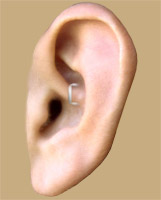 Once again I find myself muscling in on Orac’s territory. I passed through Foley, Alabama, a few times over the holidays, and on one trip I noticed a shop advertising “ear stapling” for smoking cessation and weight loss.
According to the Ear Stapling Association, the procedure is derived from ancient Chinese acupuncture.
An interesting claim from the site…
“Ear stapling has been around for decades. It has been scientifically proven that different points in the ear demonstrate high electricity that is related to different points of the body. When the body is stressed, unbalanced, or even diseased, an increase of energy is put out. In theory, energy flow is enhanced to this area of the body. This is how the staple works, by tapping into the energy flow called Chi.”
Naturally the claim that “It has been scientifically proven that different points in the ear demonstrate high electricity that is related to different points of the body” doesn’t include a reference. Don’t they know that when you make a claim of scientific support, you’re supposed to identify the source? Ads for pharmaceuticals are covered with fine print referring to the studies conducted to prove that their products are both safe and effective. Unfortunately, purveyors of woo are held to a much lower standard.
Here’s another good give-away quote…
“It is believed that one ear is more effective than the other.”
When people start telling you about something that “is believed” without specifying who believes it and why they believe it, you know you’re dealing with a claim that has no legitimate supporting evidence.
“Ear Stapling is perfectly safe and there are no side effects regarding any medical condition.”
The safety claim is quite valid; useless treatments are quite often harmless treatments. Ear stapling is certainly no more dangerous than a cosmetic ear piercing, and millions of people have gotten those without harm. It’s also a no-brainer that ear stapling should have no medical side effects, since there’s no evidence that it has any medical effects at all, good or bad.
“Within the first seven days 90% of our participants report an average weight loss of 4-5 pounds. Our participants that wish to stop smoking have reported to us that within the first 24 hours their craving for cigarettes is cut almost in half.”
I daresay the results are probably the same for any other placebo; people tend to be motivated immediately after they’ve undergone a painful and costly procedure to help them with a specific behavioral problem. Of course, Dr. Martinez doesn’t provide any long-term success statistics for his patients. Information like that would probably be damning, if it were collected and examined properly.
Ear stapling is a good way to lose some money and take a small risk of infection to accomplish nothing of consequence.
Friday, December 22, 2006
Skepticality and Silliness
The 50th Skeptics' Circle is up over at Humbug Online. If you're reading this, you probably already read my entry, but there's plenty of other good skepticism to take in at this week's circle.
Also, Reiblue introduced me to the following bit if internet silliness. The result I got amuses me so much that I feel compelled to share.
Also, Reiblue introduced me to the following bit if internet silliness. The result I got amuses me so much that I feel compelled to share.
 | My Peculiar Aristocratic Title is: His Highness Runolfr the Apocalyptic of Lesser Wobbleton Get your Peculiar Aristocratic Title |
Wednesday, December 20, 2006
Creationism in Video Game Form
In case you didn't know, the authors of the Left Behind book series have authorized a computer game called Left Behind: Eternal Forces. This is a "real time simulation" game, similar to games like Warcraft (not World of Warcraft, which is a "massively multiplayer online role-playing game"), Starcraft, Command & Conquer, and an assortment of other games that require a balance of tactical skill, strategic resource management, and mouse-clicking dexterity.
If you're not familiar with the premise, the game begins after the Biblical Rapture has occurred, and millions of people have abruptly disappeared. Those "Left Behind" have to choose sides in the final struggle on Earth between God and the Devil. It's fundamentalism all the way as you wage war against the forces of the other side (I understand that in at least some modes, you can play "the Devil's advocate") to gain the most converts and eliminate the most enemies. If you guessed that this game was a fundamentalist proselytization tool aimed at the the young video-gaming crowd, you'd be right. You can read a review at Ars Technica.
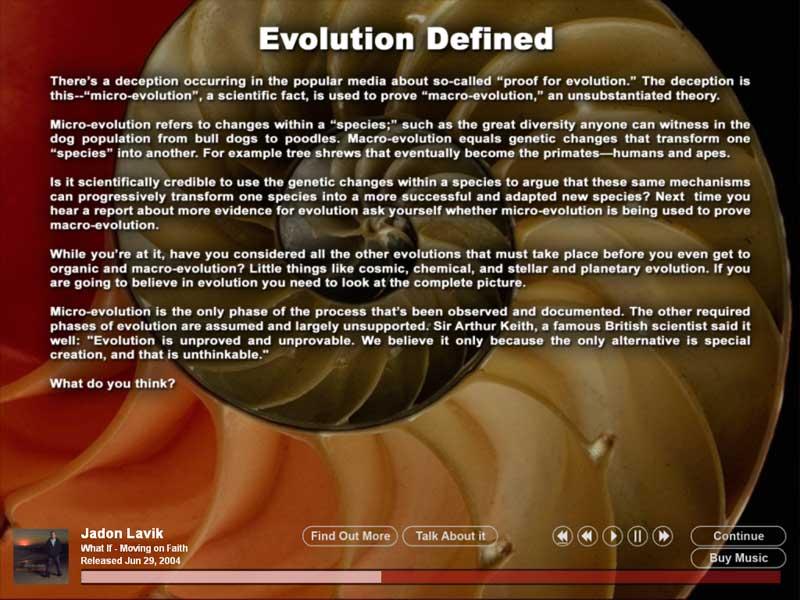
Of particular interest is a capture of an "informational" screen in the game...
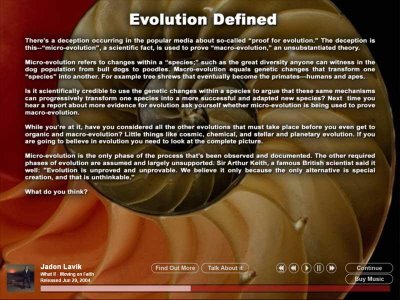
I suppose it shouldn't surprise me that a fundie video game peddles the same anti-science cliches that fill all Creationist websites and literature, but it's still annoying.
In their "Evolution for Fundies" definition, they use the oft-repeated claim that genetic variation and adaptation within a species (what they call "micro-evolution") is no reason to think that new species can diverge from such populations (what they call "macro-evolution"). Apparently they think that some magical barrier exists that keeps the adaptations from continuing and populations from becoming so dissimilar that they can no longer be considered the same species. They ask "Is it scientifically credible to use the genetic changes within a species to argue that these same mechanisms can progressively transform one species into a more successful and adapted new species?"
The question is phrased poorly, but the nutshell answer is "Yes." It is scientifically credible to argue that in a varied population, the individuals that are best adapted to the environment will have the most reproductive success, and their genes will become more common in future generations. It is scientifically credible to argue that the same mechanisms that create variation within a species can also cause populations to become non-interbreeding and progressively less similar (in both form and genetic makeup) as they adapt to different environments and ways of life. It is scientifically credible to argue that the same mechanism that drives "micro-evolution" would naturally lead to "macro-evolution". The creationists may think it's a rhetorical question, and maybe it is, but they certainly have the answer backwards.
Naturally they escalate from the question of biological evolution to universal cosmology as if the topics were the same. Why should we expect anything new from creationists? They even throw in an out-of-context quote to seal the deal.
Edit: Researching it further, the quote from Sir Arthur Keith -- "Evolution is unproved and unprovable. We believe it because the only alternative is special creation, and that is unthinkable." -- appears to be a creationist fabrication. There is no credible evidence that he said any such thing.
If you're not familiar with the premise, the game begins after the Biblical Rapture has occurred, and millions of people have abruptly disappeared. Those "Left Behind" have to choose sides in the final struggle on Earth between God and the Devil. It's fundamentalism all the way as you wage war against the forces of the other side (I understand that in at least some modes, you can play "the Devil's advocate") to gain the most converts and eliminate the most enemies. If you guessed that this game was a fundamentalist proselytization tool aimed at the the young video-gaming crowd, you'd be right. You can read a review at Ars Technica.
Of particular interest is a capture of an "informational" screen in the game...
I suppose it shouldn't surprise me that a fundie video game peddles the same anti-science cliches that fill all Creationist websites and literature, but it's still annoying.
In their "Evolution for Fundies" definition, they use the oft-repeated claim that genetic variation and adaptation within a species (what they call "micro-evolution") is no reason to think that new species can diverge from such populations (what they call "macro-evolution"). Apparently they think that some magical barrier exists that keeps the adaptations from continuing and populations from becoming so dissimilar that they can no longer be considered the same species. They ask "Is it scientifically credible to use the genetic changes within a species to argue that these same mechanisms can progressively transform one species into a more successful and adapted new species?"
The question is phrased poorly, but the nutshell answer is "Yes." It is scientifically credible to argue that in a varied population, the individuals that are best adapted to the environment will have the most reproductive success, and their genes will become more common in future generations. It is scientifically credible to argue that the same mechanisms that create variation within a species can also cause populations to become non-interbreeding and progressively less similar (in both form and genetic makeup) as they adapt to different environments and ways of life. It is scientifically credible to argue that the same mechanism that drives "micro-evolution" would naturally lead to "macro-evolution". The creationists may think it's a rhetorical question, and maybe it is, but they certainly have the answer backwards.
Naturally they escalate from the question of biological evolution to universal cosmology as if the topics were the same. Why should we expect anything new from creationists? They even throw in an out-of-context quote to seal the deal.
Edit: Researching it further, the quote from Sir Arthur Keith -- "Evolution is unproved and unprovable. We believe it because the only alternative is special creation, and that is unthinkable." -- appears to be a creationist fabrication. There is no credible evidence that he said any such thing.
Saturday, December 16, 2006
The Abbatoir
 If you're a vegetarian, or you otherwise think deer are so cute and cuddly that nothing bad should ever happen to them, click away to another site right now. This is going to be a fairly gruesome combination of pictures and descriptions.
I'm not a vegetarian. I also think that people who are going to eat meat should be willing to get their hands dirty. Too many people think meat comes from the grocery store. My grandfather took me hunting a couple of times when I was younger. I didn't kill anything on those trips, but I did pull the trigger with intent to kill a couple of times, so I'm comfortable with my place at the top of the food chain. I also helped clean and cut up the kills that other hunters made; I got over my squeamishness pretty quickly. I prefer to let others do the dirty work these days, but I will get in there when the need arises. I must admit that my good lady wife did most of the work on this occasion, but I did lend a hand as needed.
So, my father-in-law shot a deer for us a few weeks ago. It spent some time in the freezer, then a few days hanging in the cool wintery air, and today it came into the house to be dismembered. The loft design of our house, with exposed rafters, makes this process much easier, but lugging around over a hundred pounds of dead weight (yeah, pun intended) is still no easy task. Still, we managed to get the deer from its hanging place in the barn to a new hanging place in the house without too much trouble.
 The hanging, by the way, reported takes away some of the "gamey" taste that turns some people off venison and tenderizes the meat by stretching out the tissue. The "aging" process needs to occur in temperatures of around 40 degrees Fahrenheit and low humidity. It will take three to ten days, depending on temperatures. This is a bit creepy, but if you find a bit of mold growing inside the rib cage, that's actually a good sign. Where you have mold, you don't have nasty bacteria. Basically, if it's gotten slimy and stinky, it may no longer be safe. I suppose you could wash any visible mold from parts you plan to eat, but we're actually making jerky treats for our dogs from those.
I didn't think to immortalize the earliest stages of the process in pictures, so you don't have to witness the beheading and skinning of the beast. Basically, the decapitation involves cutting a ring around the neck all the way to the spine, then popping the vertebrae apart. Skinning requires cutting the skin away starting at the legs (from which the deer is suspended) and then pulling with all your weight while using a skinning knife to help the skin separate from the underlying muscle.
With the hide off, the true dismemberment began. This basically involves separating large tracts of muscle from the bone, starting with my lady's favorite cut: the backstrap. Once the assorted cuts are removed, they get washed (my job!) and refrigerated until they can be further cut down into individual servings.
The hide went into a plastic bag and then into the freezer, hopefully to eventually go into someone's leatherworking project. Assorted bones and other unpalatable bits of the animal went to a compost pile, except for a few bones that went to some extremely happy dogs.
If you're one of my local readers, and you want a deer hide for tanning, let me know.
Tuesday, December 12, 2006
Think Before You Bleed
As I donated blood today, an incident happened on one of the other couches. The donor became light-headed and nauseous shortly after starting to donate. The following conversation ensued…
NURSE: Did you eat breakfast this morning?
DONOR: No.
NURSE: What did you have for supper last night?
DONOR: (head shake with mumbled negative)
NURSE: What were you thinking donating blood when you didn’t eat dinner last night or breakfast this morning?
Saturday, December 09, 2006
Am I Obsessed?
My lady wife and I went to the Level 88 Jazz Bistro in downtown Nashville last night. They have a decent menu, a pretty good bar, and they had a really good band (which I expect is the norm for them). Plenty of customers get up and dance, as well.
Which lead to my obsessive-compulsive problem. Listening to all the jazz music and watching the dancers, I couldn't help but notice that all the songs were in 4/4 time, which means it would be easy to match them to English Country or Renaissance Italian dances. Now I need to get myself a jazz album.
How weird is that?
Which lead to my obsessive-compulsive problem. Listening to all the jazz music and watching the dancers, I couldn't help but notice that all the songs were in 4/4 time, which means it would be easy to match them to English Country or Renaissance Italian dances. Now I need to get myself a jazz album.
How weird is that?
Wednesday, December 06, 2006
How Do You Know So Much About Swallows?
If you ever wanted to really know the airspeed velocity of an unladen swallow, there's now a website to answer the question.
Monday, December 04, 2006
Pewter Casting with Two-Part Molds
 After many delays – not all avoidable – I have revisited my pewter casting work. I’ll start off by thanking my good lady wife Jolief, who assisted with every step of the process in this second effort at pewter casting.
I’ll also say upfront that this particular effort serves as an excellent proof of concept for casting items in two-part molds, but my skills as a sculptor have a long way to go.
 Our first step in this new casting project was to prepare the mold. In our case, we carved our “negative” into just one block of soapstone. I’m not ready to attempt two-sided objects just yet, so the back of the medallion we produced is flat. This isn’t a particularly complicated design. It’s really just an image of a shoe, intended for use as an “Order of the Argent Slipper” medallion.
 We completed this mold in one day by taking turns at the carving and using modern technological assistance. This isn’t intended to be an A&S competition piece, so I’m not concerned about taking such shortcuts.
 With the design complete, the next step was to carve a path to let metal into the mold and additional paths to let air escape. After doing that, all I needed to do was clamp a flat, blank piece of soapstone onto the carved mold, heat some pewter, and pour it down the funnel.
 I was surprised at how easily this part of the process worked after the difficulties I had with my attempt at an open-faced mold. The mold filled completely (and often overflowed) on every single try, producing consistent finished pieces that showcased every imperfection in my carving technique with exquisite detail.
Realizing that the initial effort to make the sole of the shoe separate from the rest of it resulted in an image that looked more like an ice skate, we attempted some correction work on the mold. It’s rather convenient to be able to do touch-up work on the mold this way, then make a new run of castings. Alas, the second round of medallions weren’t that much of an improvement.

Nonetheless, we have now established that two-part pewter castings of this type work very well with the pewter alloy that I have available. For my next effort, I will probably attempt this same work again from scratch, trying to remember that the finished product will be a mirror image of the original (so the shoe points the way I intended) and hand-carving the design to hopefully reduce the number of tool marks in the finished pieces.
EDIT: See my even-more-embarrassing first attempt.
Tuesday, November 28, 2006
I'm participating in an Experiment
Pharyngula informs us that Acephalous is conducting an experiment to see how fast links propagate over the internet. Since I've been a blog slacker for more than a week, I'll take this gratuitous opportunity to post something. It's an easy one, since all I need to do is link to Acephalous' post on the matter.
I'll also link to an amusing story about Reiki healing from the Pretentious Narcissistic Misanthrope.
I'll also link to an amusing story about Reiki healing from the Pretentious Narcissistic Misanthrope.
Tuesday, November 21, 2006
Faculty-of-Medicine Wants My Help
Once again, the subject matter for a skepticism article has come right to my email box. I received the following missive recently:
Hey, if she wants to freely share her contact information with strangers over the internet, who am I to stop her? It’s not like there’s any reason to assume this is a legitimate name, anyway.
A quick look at the “facultyofmedicine” site reveals what looks like an online bookstore. Someone has basically put together a list of vaguely medical titles with links to Amazon to sell them.
All these on a page titled “MEDICINE STUDENT BOOKS”. If this kind of material is included in medical school curricula, I feel I must quake in fear should I ever become ill.
They’re not all like that of course. There are titles like the Handbook of Evidence-based Radiation Oncology, too, but seeing the woo mixed freely with the substantiated is rather disconcerting.
One title is Outsmart Your Cancer: Alternative Non-Toxic Treatments That Work. The Amazon description says...
I guess the problem that I have with this site is that it randomly mixes unsubstantiated claims with legitimate medical literature, lending an air of credibility to the unsupported CAM books.
So, sorry Jane, but I won’t be giving you a link; I don’t want to do anything to improve your Google score. Even my readers will have to hand-key the URL into their browsers to see what I’m talking about (sorry for the inconvenience, guys).
Hi,NOTE: I recently received a message from the staff of the site that "Jane Fields" named in her email to me. The site she named disavows any connection with facultyofmedicine.net and politely asked me to remove their name from this article due to the bad publicity (apparently this page floated to the top in Google searches for their name). Since it appears that "Jane" was just name-dropping to give herself credibility, I have complied with the request.
I think your site and [sitename] can be a good match for linking.
[sitename] does not have a link page, but we offer three way linking (better than the usual linking) from facultyofmedicine.net.
If this is of any interest to you please respond.
Thanks,
Jane Fields,
POB 200067, Pittsburgh, PA
Hey, if she wants to freely share her contact information with strangers over the internet, who am I to stop her? It’s not like there’s any reason to assume this is a legitimate name, anyway.
A quick look at the “facultyofmedicine” site reveals what looks like an online bookstore. Someone has basically put together a list of vaguely medical titles with links to Amazon to sell them.
Browse through an extensive selection of Medicine books on subjects such as Anatomy, Cardiology, Neurology and more.This doesn’t seem like such a bad site. It's a simple money maker for someone who wants to make money off medical students without actually having to maintain an inventory, but there's nothing wrong with that. Of course, scrolling down the page, what should I find as the sixth book on their list but...
Natural Cures "They" Don't Want You To Know About Written by Kevin TrudeauFollowed by a couple more beauties like Suzanne Somers' Slim & Sexy Forever: The Hormone Solution for Permanent Weight Loss & Optimal Living and Everything You Need to Know to Feel Go(o)d.
All these on a page titled “MEDICINE STUDENT BOOKS”. If this kind of material is included in medical school curricula, I feel I must quake in fear should I ever become ill.
They’re not all like that of course. There are titles like the Handbook of Evidence-based Radiation Oncology, too, but seeing the woo mixed freely with the substantiated is rather disconcerting.
One title is Outsmart Your Cancer: Alternative Non-Toxic Treatments That Work. The Amazon description says...
Learn the unique characteristics common to all cancers. Read testimonials from many who have completely recovered using alternative approaches. Learn why non-toxic methods are so effective and how to obtain them.Testimonials instead of evidence; this does not bode well. I’m sure Orac can do a much better job of examining such claims than I can, but I would far sooner follow the instructions of an experienced medical doctor than the advice of someone with no medical training of any kind (and no, the author -- Tanya Harter Pierce – is not a doctor).
I guess the problem that I have with this site is that it randomly mixes unsubstantiated claims with legitimate medical literature, lending an air of credibility to the unsupported CAM books.
So, sorry Jane, but I won’t be giving you a link; I don’t want to do anything to improve your Google score. Even my readers will have to hand-key the URL into their browsers to see what I’m talking about (sorry for the inconvenience, guys).
Monday, November 13, 2006
My Accent Results
Several of the weblogs I read have been passing around this quiz lately, so I thought I would take it and see what happened. I figured the results would not be exactly consistent with where I live, and I was not disappointed.
So, based on that, would it surprise you to know that I was born and raised in East Tennesse, and that both of my parents are from south Alabama? I also went to college in South Carolina, if you think that's relevant. I have no explanation, but it was interesting to have this test affirm what other people have told me.
| What American accent do you have? Your Result: The Midland "You have a Midland accent" is just another way of saying "you don't have an accent." You probably are from the Midland (Pennsylvania, southern Ohio, southern Indiana, southern Illinois, and Missouri) but then for all we know you could be from Florida or Charleston or one of those big southern cities like Atlanta or Dallas. You have a good voice for TV and radio. | |
| The South | |
| Philadelphia | |
| The Inland North | |
| The Northeast | |
| The West | |
| Boston | |
| North Central | |
| What American accent do you have? Take More Quizzes | |
So, based on that, would it surprise you to know that I was born and raised in East Tennesse, and that both of my parents are from south Alabama? I also went to college in South Carolina, if you think that's relevant. I have no explanation, but it was interesting to have this test affirm what other people have told me.
Sunday, November 12, 2006
Bringing Forth Wine
 This has been a busy day for us, but all likeable activities. We racked my Lady's "Grog" (a molasses beer), bottled Apricot Wine and Sassafras Mead, and started a new batch of Concord Wine.
We had originally planned to bottle the Grog, but I miscalculated the amount of priming sugar. It's a one-gallon batch, but without thinking I quoted the sugar addition for a five-gallon batch. Not wanting to create grenades, we decided to rack it into another carboy and let it ferment out the excess sugar.
Bottling the Apricot Wine was the second project of the day. This wine was made from common white grape juice (Niagara is the variety used, I'm told) mixed with "apricot nectar". I don't actually know what makes "nectar" different from "juice", but it certainly seems to carry a lot of flavor. This is actually a pretty simple sweet wine, so fancy bottling wasn't required. We used miniature soda bottles with crown caps.
 |  | 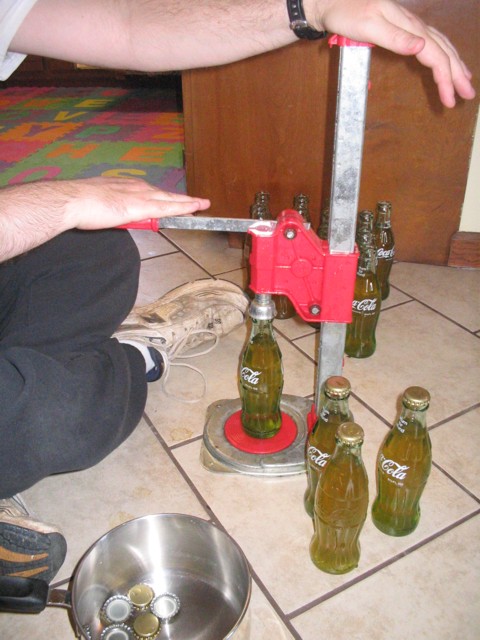 |

 After bottling the wine, we moved on to bottling the Sassafras Mead. As with our last batch, this mead has exquisite color and clarity. Unlike the last batch, this one is almost drinkable already. It still has a bit of a jet fuel aftertaste, though, so it will get to lay in a wine rack for a year or so before we serve it to anyone. If past experience is any guide, this will be an excellent mead in a few years.
 Our final project of the day was to start a brand new batch of Concord Wine. We've made this wine before as a sparkling wine that carbonates in the bottle (and won a blue ribbon in the sparkling division at the Tennessee Viticultural & Oenological Society wine contest, I might add). We'll be using slightly easier methods this time; this will be a sweet, still wine that we'll "bottle" in a cornelius keg and then pressurize. Our objective is to have it ready in time for Gulf Wars XVI.
This batch of wine started with common Concord grape juice that you can find at any grocery. Having more presence of mind than usual, I remembered to take hydrometer readings of the juice before starting fermentation. Our juice had a specific gravity of 1.065, which is sweet enough to carry the wine to about 8% alcohol after fermentation. That's not enough; the wine wouldn't be strong enough to keep vinegar bacteria from establishing themselves. We therefore needed to add some sugar.
 |  |  |
 This operation involved dumping five pounds of sugar into an empty grapejuice bottle, pouring about half a bottle of juice in after, and then shaking vigorously to mix the sugar into the juice. We then poured the mixture into the carboy. This little operation brought the specific gravity up to 1.100, which should make a wine with about 13% alcohol.
 After proofing some Lalvin 71B-1122 wine yeast (saccharomyces cerevisiae), we added it to the carboy, and we saw the first signs of fermentation within the hour. The wine can sit quietly in a corner for a few weeks while it goes through its primary fermentation. After that, it should slow down enough for its first racking.
I shall try to remember to document the entire procedure here at the Saga.
Thursday, November 09, 2006
Skeptics' Circle 47
Drat! Somehow the 47th Skeptics' Circle of Heroes snuck up on me without me even noticing. Oh well, I guess I now have two weeks to come up with something. Head on over to Polite Company to see what the more alert crowd of skeptics has to offer this week.
Wednesday, November 08, 2006
Slashing Soapstone
 In my very slow quest to cast some nice pewter medallions, I acquired a large slab of soapstone for making two-part molds. I'm switching to two part molds instead of open molds because the pewter I'm using isn't particularly well suited to open-faced casting, and I'm not keen to alloy it with lead so it will be more suited to that method. No, I'd rather avoid the toxic heavy metals as much as I may.
Consequently, I needed to cut my slab of soapstone down to manageable-sized blocks. Soapstone is a pretty soft stone that's easy to carve and cut, of course, so I figured that a bit of work with a hacksaw would make neat pieces without too much difficulty. Needless to say that was a notion born from a deranged thread of optimism floating idly through my addled mind. A hacksaw will certainly cut through soapstone, but it is abysmally slow going, as roughly an hour (non-continuous) of hacking didn't even get half way through the block.
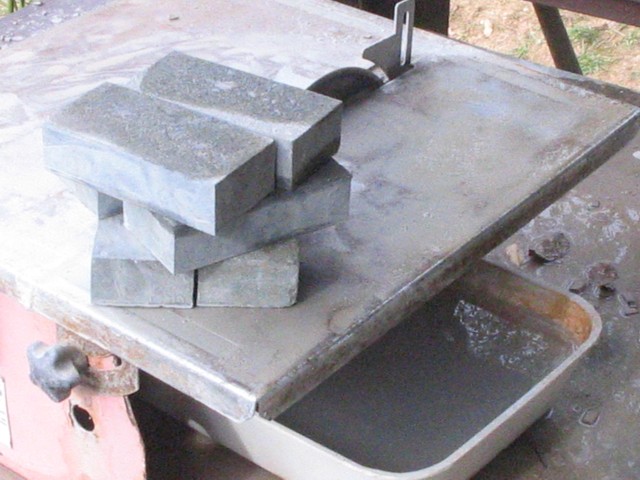 Unrelated events happened to work in my favor, though. As I mentioned long ago, the catastrophic failure of our water heater forced us to rip out our carpeting, and we spent much of the last few months laying a tile floor in its place. My brother- and sister-in-law loaned us a tile-cutting table-saw for the duration of the project, and after the floor was finished, I took the opportunity to turn that stone cutting blade against my slab of soapstone. In just a few seconds it cut through more soapstone than I'd been able to go through in nearly an hour of hacking.
So, soapstone blocks secured, I must now find time to carve some molds.
Wednesday, November 01, 2006
Nautical Nonsense for Halloween
 Our second annual Halloween Party was a success this year. At least I think so, and I've gotten good feedback so far.
As usual we had a few games planned, some for kids and some for adults. The main kid-friendly game was the treasure hunt. Since it was a nautically themed party, this was a supposed pirate treasure hidden somewhere on the property. We came up with a few clues to lead participating guests on a merry chase through the fields (in the dark, with only two flashlights). We tried not to be too stingy with the treasure, either: we put actual cash in there along with an assortment of costume jewelry. Since the treasure chest and the key were hidden separately (ah, gotta love movie inspiration), the finders of each ended up splitting the treasure.
Other entertainments included a surprising amount of renaissance dancing (not expected, but definitely welcome), rubber duck races, and a game of fishing for bottles. The bottle fishing was the brutal adult game, since we were talking mini-bottles, and you had to empty the one you caught before you could cast for another. I had to recover for about an hour after that one.
We also had a costume contest with a lot of interesting costumes. A few pirates, of course; the goddess Thetis; the 13th Warrior (who changed costumes to a pirate later); the figurehead of a ship; an island; an aquarium; and a sailor. The island got the prize.
 Good food and drink always help make a party, so we included contests for them as well. My Captain Jack won best drink, since no one else entered anything, but we had several entries in the food contest.
We're looking forward to an "Animated Characters" themed party for next year.
Subscribe to:
Posts (Atom)