My lady wife and I went to the Level 88 Jazz Bistro in downtown Nashville last night. They have a decent menu, a pretty good bar, and they had a really good band (which I expect is the norm for them). Plenty of customers get up and dance, as well.
Which lead to my obsessive-compulsive problem. Listening to all the jazz music and watching the dancers, I couldn't help but notice that all the songs were in 4/4 time, which means it would be easy to match them to English Country or Renaissance Italian dances. Now I need to get myself a jazz album.
How weird is that?
Saturday, December 09, 2006

Wednesday, December 06, 2006
How Do You Know So Much About Swallows?
If you ever wanted to really know the airspeed velocity of an unladen swallow, there's now a website to answer the question.
Monday, December 04, 2006
Pewter Casting with Two-Part Molds
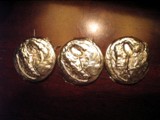 After many delays – not all avoidable – I have revisited my pewter casting work. I’ll start off by thanking my good lady wife Jolief, who assisted with every step of the process in this second effort at pewter casting.
I’ll also say upfront that this particular effort serves as an excellent proof of concept for casting items in two-part molds, but my skills as a sculptor have a long way to go.
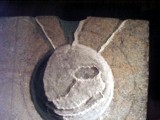
 Our first step in this new casting project was to prepare the mold. In our case, we carved our “negative” into just one block of soapstone. I’m not ready to attempt two-sided objects just yet, so the back of the medallion we produced is flat. This isn’t a particularly complicated design. It’s really just an image of a shoe, intended for use as an “Order of the Argent Slipper” medallion.
 We completed this mold in one day by taking turns at the carving and using modern technological assistance. This isn’t intended to be an A&S competition piece, so I’m not concerned about taking such shortcuts.
 With the design complete, the next step was to carve a path to let metal into the mold and additional paths to let air escape. After doing that, all I needed to do was clamp a flat, blank piece of soapstone onto the carved mold, heat some pewter, and pour it down the funnel.
 I was surprised at how easily this part of the process worked after the difficulties I had with my attempt at an open-faced mold. The mold filled completely (and often overflowed) on every single try, producing consistent finished pieces that showcased every imperfection in my carving technique with exquisite detail.
Realizing that the initial effort to make the sole of the shoe separate from the rest of it resulted in an image that looked more like an ice skate, we attempted some correction work on the mold. It’s rather convenient to be able to do touch-up work on the mold this way, then make a new run of castings. Alas, the second round of medallions weren’t that much of an improvement.

Nonetheless, we have now established that two-part pewter castings of this type work very well with the pewter alloy that I have available. For my next effort, I will probably attempt this same work again from scratch, trying to remember that the finished product will be a mirror image of the original (so the shoe points the way I intended) and hand-carving the design to hopefully reduce the number of tool marks in the finished pieces.
EDIT: See my even-more-embarrassing first attempt.
Tuesday, November 28, 2006
I'm participating in an Experiment
Pharyngula informs us that Acephalous is conducting an experiment to see how fast links propagate over the internet. Since I've been a blog slacker for more than a week, I'll take this gratuitous opportunity to post something. It's an easy one, since all I need to do is link to Acephalous' post on the matter.
I'll also link to an amusing story about Reiki healing from the Pretentious Narcissistic Misanthrope.
I'll also link to an amusing story about Reiki healing from the Pretentious Narcissistic Misanthrope.
Tuesday, November 21, 2006
Faculty-of-Medicine Wants My Help
Once again, the subject matter for a skepticism article has come right to my email box. I received the following missive recently:
Hey, if she wants to freely share her contact information with strangers over the internet, who am I to stop her? It’s not like there’s any reason to assume this is a legitimate name, anyway.
A quick look at the “facultyofmedicine” site reveals what looks like an online bookstore. Someone has basically put together a list of vaguely medical titles with links to Amazon to sell them.
All these on a page titled “MEDICINE STUDENT BOOKS”. If this kind of material is included in medical school curricula, I feel I must quake in fear should I ever become ill.
They’re not all like that of course. There are titles like the Handbook of Evidence-based Radiation Oncology, too, but seeing the woo mixed freely with the substantiated is rather disconcerting.
One title is Outsmart Your Cancer: Alternative Non-Toxic Treatments That Work. The Amazon description says...
I guess the problem that I have with this site is that it randomly mixes unsubstantiated claims with legitimate medical literature, lending an air of credibility to the unsupported CAM books.
So, sorry Jane, but I won’t be giving you a link; I don’t want to do anything to improve your Google score. Even my readers will have to hand-key the URL into their browsers to see what I’m talking about (sorry for the inconvenience, guys).
Hi,NOTE: I recently received a message from the staff of the site that "Jane Fields" named in her email to me. The site she named disavows any connection with facultyofmedicine.net and politely asked me to remove their name from this article due to the bad publicity (apparently this page floated to the top in Google searches for their name). Since it appears that "Jane" was just name-dropping to give herself credibility, I have complied with the request.
I think your site and [sitename] can be a good match for linking.
[sitename] does not have a link page, but we offer three way linking (better than the usual linking) from facultyofmedicine.net.
If this is of any interest to you please respond.
Thanks,
Jane Fields,
POB 200067, Pittsburgh, PA
Hey, if she wants to freely share her contact information with strangers over the internet, who am I to stop her? It’s not like there’s any reason to assume this is a legitimate name, anyway.
A quick look at the “facultyofmedicine” site reveals what looks like an online bookstore. Someone has basically put together a list of vaguely medical titles with links to Amazon to sell them.
Browse through an extensive selection of Medicine books on subjects such as Anatomy, Cardiology, Neurology and more.This doesn’t seem like such a bad site. It's a simple money maker for someone who wants to make money off medical students without actually having to maintain an inventory, but there's nothing wrong with that. Of course, scrolling down the page, what should I find as the sixth book on their list but...
Natural Cures "They" Don't Want You To Know About Written by Kevin TrudeauFollowed by a couple more beauties like Suzanne Somers' Slim & Sexy Forever: The Hormone Solution for Permanent Weight Loss & Optimal Living and Everything You Need to Know to Feel Go(o)d.
All these on a page titled “MEDICINE STUDENT BOOKS”. If this kind of material is included in medical school curricula, I feel I must quake in fear should I ever become ill.
They’re not all like that of course. There are titles like the Handbook of Evidence-based Radiation Oncology, too, but seeing the woo mixed freely with the substantiated is rather disconcerting.
One title is Outsmart Your Cancer: Alternative Non-Toxic Treatments That Work. The Amazon description says...
Learn the unique characteristics common to all cancers. Read testimonials from many who have completely recovered using alternative approaches. Learn why non-toxic methods are so effective and how to obtain them.Testimonials instead of evidence; this does not bode well. I’m sure Orac can do a much better job of examining such claims than I can, but I would far sooner follow the instructions of an experienced medical doctor than the advice of someone with no medical training of any kind (and no, the author -- Tanya Harter Pierce – is not a doctor).
I guess the problem that I have with this site is that it randomly mixes unsubstantiated claims with legitimate medical literature, lending an air of credibility to the unsupported CAM books.
So, sorry Jane, but I won’t be giving you a link; I don’t want to do anything to improve your Google score. Even my readers will have to hand-key the URL into their browsers to see what I’m talking about (sorry for the inconvenience, guys).
Monday, November 13, 2006
My Accent Results
Several of the weblogs I read have been passing around this quiz lately, so I thought I would take it and see what happened. I figured the results would not be exactly consistent with where I live, and I was not disappointed.
So, based on that, would it surprise you to know that I was born and raised in East Tennesse, and that both of my parents are from south Alabama? I also went to college in South Carolina, if you think that's relevant. I have no explanation, but it was interesting to have this test affirm what other people have told me.
| What American accent do you have? Your Result: The Midland "You have a Midland accent" is just another way of saying "you don't have an accent." You probably are from the Midland (Pennsylvania, southern Ohio, southern Indiana, southern Illinois, and Missouri) but then for all we know you could be from Florida or Charleston or one of those big southern cities like Atlanta or Dallas. You have a good voice for TV and radio. | |
| The South | |
| Philadelphia | |
| The Inland North | |
| The Northeast | |
| The West | |
| Boston | |
| North Central | |
| What American accent do you have? Take More Quizzes | |
So, based on that, would it surprise you to know that I was born and raised in East Tennesse, and that both of my parents are from south Alabama? I also went to college in South Carolina, if you think that's relevant. I have no explanation, but it was interesting to have this test affirm what other people have told me.
Sunday, November 12, 2006
Bringing Forth Wine
 This has been a busy day for us, but all likeable activities. We racked my Lady's "Grog" (a molasses beer), bottled Apricot Wine and Sassafras Mead, and started a new batch of Concord Wine.
We had originally planned to bottle the Grog, but I miscalculated the amount of priming sugar. It's a one-gallon batch, but without thinking I quoted the sugar addition for a five-gallon batch. Not wanting to create grenades, we decided to rack it into another carboy and let it ferment out the excess sugar.
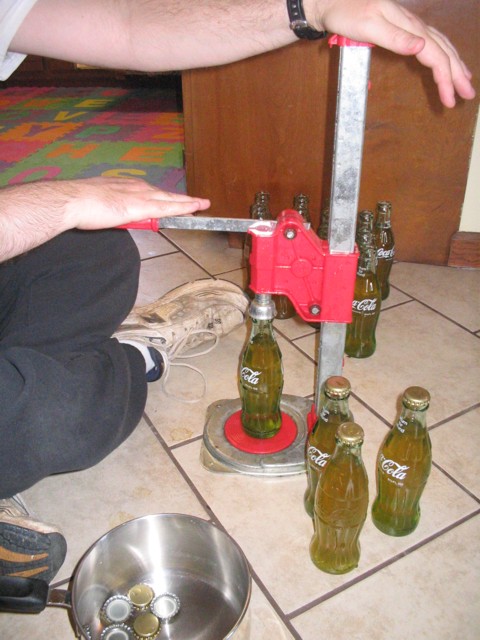
Bottling the Apricot Wine was the second project of the day. This wine was made from common white grape juice (Niagara is the variety used, I'm told) mixed with "apricot nectar". I don't actually know what makes "nectar" different from "juice", but it certainly seems to carry a lot of flavor. This is actually a pretty simple sweet wine, so fancy bottling wasn't required. We used miniature soda bottles with crown caps.
 |  |  |

 After bottling the wine, we moved on to bottling the Sassafras Mead. As with our last batch, this mead has exquisite color and clarity. Unlike the last batch, this one is almost drinkable already. It still has a bit of a jet fuel aftertaste, though, so it will get to lay in a wine rack for a year or so before we serve it to anyone. If past experience is any guide, this will be an excellent mead in a few years.
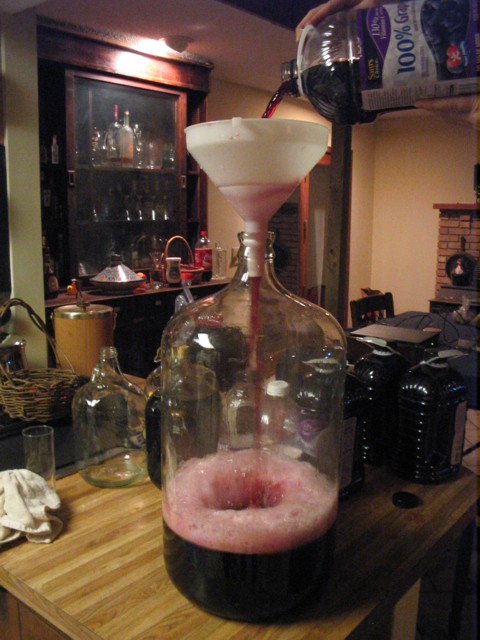 Our final project of the day was to start a brand new batch of Concord Wine. We've made this wine before as a sparkling wine that carbonates in the bottle (and won a blue ribbon in the sparkling division at the Tennessee Viticultural & Oenological Society wine contest, I might add). We'll be using slightly easier methods this time; this will be a sweet, still wine that we'll "bottle" in a cornelius keg and then pressurize. Our objective is to have it ready in time for Gulf Wars XVI.
This batch of wine started with common Concord grape juice that you can find at any grocery. Having more presence of mind than usual, I remembered to take hydrometer readings of the juice before starting fermentation. Our juice had a specific gravity of 1.065, which is sweet enough to carry the wine to about 8% alcohol after fermentation. That's not enough; the wine wouldn't be strong enough to keep vinegar bacteria from establishing themselves. We therefore needed to add some sugar.
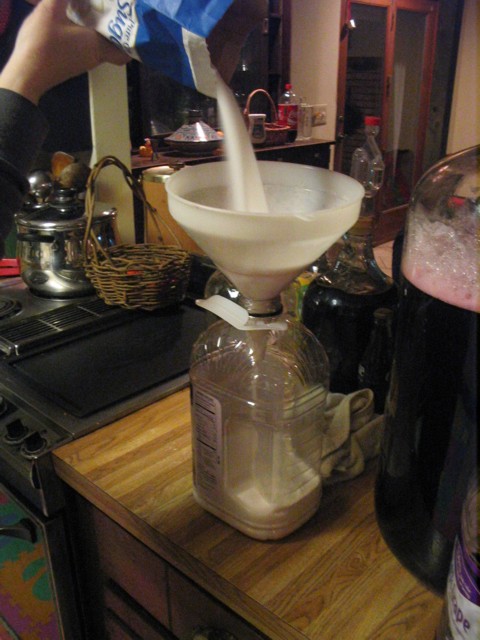 |  |  |
 This operation involved dumping five pounds of sugar into an empty grapejuice bottle, pouring about half a bottle of juice in after, and then shaking vigorously to mix the sugar into the juice. We then poured the mixture into the carboy. This little operation brought the specific gravity up to 1.100, which should make a wine with about 13% alcohol.
 After proofing some Lalvin 71B-1122 wine yeast (saccharomyces cerevisiae), we added it to the carboy, and we saw the first signs of fermentation within the hour. The wine can sit quietly in a corner for a few weeks while it goes through its primary fermentation. After that, it should slow down enough for its first racking.
I shall try to remember to document the entire procedure here at the Saga.
Thursday, November 09, 2006
Skeptics' Circle 47
Drat! Somehow the 47th Skeptics' Circle of Heroes snuck up on me without me even noticing. Oh well, I guess I now have two weeks to come up with something. Head on over to Polite Company to see what the more alert crowd of skeptics has to offer this week.
Wednesday, November 08, 2006
Slashing Soapstone
 In my very slow quest to cast some nice pewter medallions, I acquired a large slab of soapstone for making two-part molds. I'm switching to two part molds instead of open molds because the pewter I'm using isn't particularly well suited to open-faced casting, and I'm not keen to alloy it with lead so it will be more suited to that method. No, I'd rather avoid the toxic heavy metals as much as I may.
Consequently, I needed to cut my slab of soapstone down to manageable-sized blocks. Soapstone is a pretty soft stone that's easy to carve and cut, of course, so I figured that a bit of work with a hacksaw would make neat pieces without too much difficulty. Needless to say that was a notion born from a deranged thread of optimism floating idly through my addled mind. A hacksaw will certainly cut through soapstone, but it is abysmally slow going, as roughly an hour (non-continuous) of hacking didn't even get half way through the block.
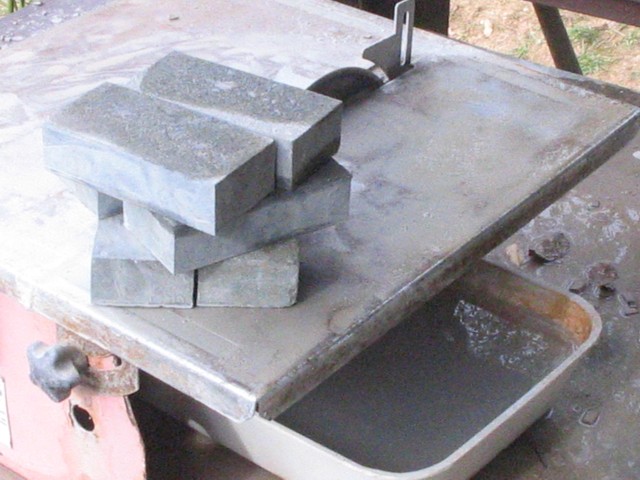 Unrelated events happened to work in my favor, though. As I mentioned long ago, the catastrophic failure of our water heater forced us to rip out our carpeting, and we spent much of the last few months laying a tile floor in its place. My brother- and sister-in-law loaned us a tile-cutting table-saw for the duration of the project, and after the floor was finished, I took the opportunity to turn that stone cutting blade against my slab of soapstone. In just a few seconds it cut through more soapstone than I'd been able to go through in nearly an hour of hacking.
So, soapstone blocks secured, I must now find time to carve some molds.
Wednesday, November 01, 2006
Nautical Nonsense for Halloween
 Our second annual Halloween Party was a success this year. At least I think so, and I've gotten good feedback so far.
As usual we had a few games planned, some for kids and some for adults. The main kid-friendly game was the treasure hunt. Since it was a nautically themed party, this was a supposed pirate treasure hidden somewhere on the property. We came up with a few clues to lead participating guests on a merry chase through the fields (in the dark, with only two flashlights). We tried not to be too stingy with the treasure, either: we put actual cash in there along with an assortment of costume jewelry. Since the treasure chest and the key were hidden separately (ah, gotta love movie inspiration), the finders of each ended up splitting the treasure.
Other entertainments included a surprising amount of renaissance dancing (not expected, but definitely welcome), rubber duck races, and a game of fishing for bottles. The bottle fishing was the brutal adult game, since we were talking mini-bottles, and you had to empty the one you caught before you could cast for another. I had to recover for about an hour after that one.
We also had a costume contest with a lot of interesting costumes. A few pirates, of course; the goddess Thetis; the 13th Warrior (who changed costumes to a pirate later); the figurehead of a ship; an island; an aquarium; and a sailor. The island got the prize.
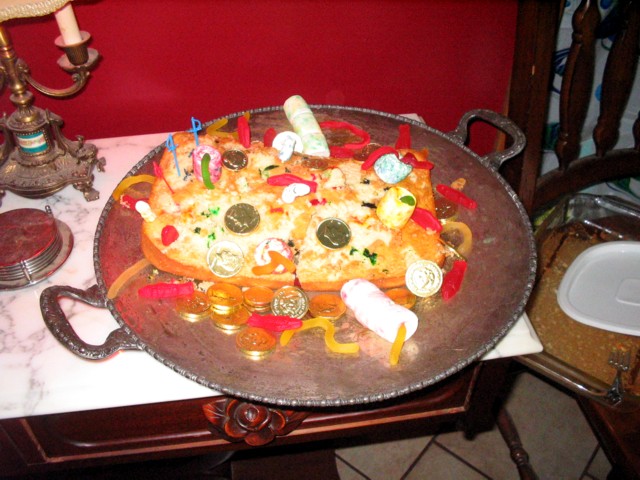 Good food and drink always help make a party, so we included contests for them as well. My Captain Jack won best drink, since no one else entered anything, but we had several entries in the food contest.
We're looking forward to an "Animated Characters" themed party for next year.
Wednesday, October 25, 2006
Movie Review: Beowulf & Grendel
Well, we watched Beowulf & Grendel last night, and I was not impressed. It didn’t completely suck, but it was neither “authentic” nor terribly clever.
A better title might have been the “The Vengeance of Poor Misunderstood Grendel Upon the Redneck Danes”. Seriously, the Danes and Geats act like a bunch of rednecks constantly dropping the F-word in Scottish accents. At least the rednecks are smart enough to wear their helmets when they go into a fight.
Grendel is vaguely like an adolescent taking revenge for a legitimate wrong. He lacks the supernatural invulnerability that helped define Grendel in the poem. He's just big, strong, and cunning in a neanderthalish kind of way. He's obviously meant to be a sympathetic character, and quite frankly kicks the butts of Beowulf and everyone else he fights. He pwnez Beowulf and company so bad that he actually has to cut his own arm off so it can get nailed to the wall.
And then there’s the witch Selma, played by Sarah Polley, who helps the story by dropping hints about her friend Grendel’s motivations in an undisguised American accent.
Add in a disposable subplot involving a Christian missionary and a gratuitous visit from Grendel's mother, and you've got something resembling a story that doesn't very much resemble the classic Beowulf.
I’d give this two out of five stars, I guess. Don’t rush to the video store.
A better title might have been the “The Vengeance of Poor Misunderstood Grendel Upon the Redneck Danes”. Seriously, the Danes and Geats act like a bunch of rednecks constantly dropping the F-word in Scottish accents. At least the rednecks are smart enough to wear their helmets when they go into a fight.
Grendel is vaguely like an adolescent taking revenge for a legitimate wrong. He lacks the supernatural invulnerability that helped define Grendel in the poem. He's just big, strong, and cunning in a neanderthalish kind of way. He's obviously meant to be a sympathetic character, and quite frankly kicks the butts of Beowulf and everyone else he fights. He pwnez Beowulf and company so bad that he actually has to cut his own arm off so it can get nailed to the wall.
And then there’s the witch Selma, played by Sarah Polley, who helps the story by dropping hints about her friend Grendel’s motivations in an undisguised American accent.
Add in a disposable subplot involving a Christian missionary and a gratuitous visit from Grendel's mother, and you've got something resembling a story that doesn't very much resemble the classic Beowulf.
I’d give this two out of five stars, I guess. Don’t rush to the video store.
Tuesday, October 24, 2006
Random Musings
Home refurbishing is finally nearing completion. Every piece of tile for the floor has been cut, only about six need to be actually laid in place, and at least half of the floor is already grouted. The final steps should be done in the next couple of days. I’m looking forward to having nights and weekends again.
Speaking of weekends, our annual Halloween party is coming up. I will try to remember to take more pictures this year. Owing to the gratuitous emptiness of the house (due to the floor replacement), we should have plenty of room to bring the festivities indoors for the most part.
Beowulf & Grendel has finally come out on DVD in this country. I’ve been waiting for this release for a while; I really, really hope it doesn’t suck. We may watch it tonight, so I may write a review in the next couple of days.
We’ve also managed to become addicted to Heroes over the last few weeks. Don’t let my skeptical writings fool you; I love this kind of stuff.
Speaking of weekends, our annual Halloween party is coming up. I will try to remember to take more pictures this year. Owing to the gratuitous emptiness of the house (due to the floor replacement), we should have plenty of room to bring the festivities indoors for the most part.
Beowulf & Grendel has finally come out on DVD in this country. I’ve been waiting for this release for a while; I really, really hope it doesn’t suck. We may watch it tonight, so I may write a review in the next couple of days.
We’ve also managed to become addicted to Heroes over the last few weeks. Don’t let my skeptical writings fool you; I love this kind of stuff.
Tuesday, October 17, 2006
More Hollywood Antiscience
I don't want to harp too much on Hollywood's screenwriters; it's not like they have degrees in astrophysics or anything. They just want interesting plot devices for their stories, and they usually don't have the time or inclination to consult a qualified expert, even if they knew one, to see if their ideas are scientifically plausible. Consequently, they write scientifically preposterous plot devices that require great acts of suspension of disbelief from anyone with a scientific background. Now, I'm not saying that gross misrepresentations well-established laws of physics should keep you from enjoying the programs; I enjoy watching them myself. Just don't be fooled into thinking that there's a scientific clue being exercised in the writing studio, even if the show claims to be a "hard science fiction show". All that said, let's look at a couple of repetitive anti-science cliches that have come out of the TV industry.
Time Stopping
This is the supernatural ability of the character Hiro in the NBC series Heroes, as well as a plot point in Star Trek episodes like "Wink of an Eye" from the original series and "Timescape" from The Next Generation.
The plot gimmick in these shows is that time somehow stops or gets slowed tremendously for some characters while continuing normally for others. This means that you have some characters walking around and interacting normally with the environment while the rest are "frozen" by comparison.
Unfortunately, Hollywood writers never consider the consequences of someone experiencing time at a rate hundreds or thousands of times greater than others. As Mike Wong has pointed out on his website in relation to Star Trek, all kinds of things are time dependent that science fiction TV writers don't think about.
For example, the light by which we see is actually time dependent. A 100-watt lightbulb, for instance, is defined by the fact that it converts 100 joules of energy from electrical current into heat and light every second. If a hero alters time so that he's moving 1000 times faster than everyone else, then all the 100-watt bulbs he might be using to see become -- from his point of view -- 0.1-watt lightbulbs, and he's suddenly wandering about in the dark.
Interacting with the environment doesn't stop with sight, either. If you're going 1000 times faster than everyone else, you experience 1000 times as much air resistance as everyone else. From your perspective, the air might feel as thick as water (or worse). Even if your time-bending ability allowed you to move through the air normally, the friction created by your passing would create a super-heated shockwave wherever you went that would blast everyone you walked by (and you, too, when you allowed yourself to return to "normal" speed). If you exert five pounds of force to move an object, that object will actually experience five thousand pounds of force in normal time (which would be sufficient to damage many things you might want to move).
And finally, if you literally "stop time" for everything else, you can't do anything. You can't see, because no light is reaching your eyes. You can't move, because the immobile air is an impenetrable barrier. Actually stopping time would just be an exercise in sensory deprivation (until you suffocate from lack of oxygen, that is).
Sudden Evolution
Offenders in this category include the Star Trek: The Next Generation episode "Transfigurations", the Babylon 5 episode "Mind War", and the B5 TV movie River of Souls. These shows all describe an "evolutionary" change in which living beings of some alien race of the week transform in a bright flash from ordinary flesh-and-blood humanoids into "pure energy" beings who fly away into space (or do other things that only pure-energy beings could do).
To put it bluntly, such a transformation is not "evolutionary". In fact, it's the total opposite of evolution. If the general public got their understanding of the Theory of Evolution from shows like this, it's no wonder that they don't take the theory seriously. Evolution is about tiny variations that accumulate over the course of many generations, not dramatic changes in living examples of a species.
Moral of the Story
If you go to Hollywood for scientific understanding, you become the blind following the blind.
Time Stopping
This is the supernatural ability of the character Hiro in the NBC series Heroes, as well as a plot point in Star Trek episodes like "Wink of an Eye" from the original series and "Timescape" from The Next Generation.
The plot gimmick in these shows is that time somehow stops or gets slowed tremendously for some characters while continuing normally for others. This means that you have some characters walking around and interacting normally with the environment while the rest are "frozen" by comparison.
Unfortunately, Hollywood writers never consider the consequences of someone experiencing time at a rate hundreds or thousands of times greater than others. As Mike Wong has pointed out on his website in relation to Star Trek, all kinds of things are time dependent that science fiction TV writers don't think about.
For example, the light by which we see is actually time dependent. A 100-watt lightbulb, for instance, is defined by the fact that it converts 100 joules of energy from electrical current into heat and light every second. If a hero alters time so that he's moving 1000 times faster than everyone else, then all the 100-watt bulbs he might be using to see become -- from his point of view -- 0.1-watt lightbulbs, and he's suddenly wandering about in the dark.
Interacting with the environment doesn't stop with sight, either. If you're going 1000 times faster than everyone else, you experience 1000 times as much air resistance as everyone else. From your perspective, the air might feel as thick as water (or worse). Even if your time-bending ability allowed you to move through the air normally, the friction created by your passing would create a super-heated shockwave wherever you went that would blast everyone you walked by (and you, too, when you allowed yourself to return to "normal" speed). If you exert five pounds of force to move an object, that object will actually experience five thousand pounds of force in normal time (which would be sufficient to damage many things you might want to move).
And finally, if you literally "stop time" for everything else, you can't do anything. You can't see, because no light is reaching your eyes. You can't move, because the immobile air is an impenetrable barrier. Actually stopping time would just be an exercise in sensory deprivation (until you suffocate from lack of oxygen, that is).
Sudden Evolution
Offenders in this category include the Star Trek: The Next Generation episode "Transfigurations", the Babylon 5 episode "Mind War", and the B5 TV movie River of Souls. These shows all describe an "evolutionary" change in which living beings of some alien race of the week transform in a bright flash from ordinary flesh-and-blood humanoids into "pure energy" beings who fly away into space (or do other things that only pure-energy beings could do).
To put it bluntly, such a transformation is not "evolutionary". In fact, it's the total opposite of evolution. If the general public got their understanding of the Theory of Evolution from shows like this, it's no wonder that they don't take the theory seriously. Evolution is about tiny variations that accumulate over the course of many generations, not dramatic changes in living examples of a species.
Moral of the Story
If you go to Hollywood for scientific understanding, you become the blind following the blind.
Sunday, October 15, 2006
Rapier Drill: Blade Control
You get a surprising amount of touches in SCA fencing by wrestling about your opponents blade to get your point on target while keeping your opponent's point at bay. Of course, in SCA fencing, you can't actually grab your opponent, only his or her weapon. Practicing at this sort of blade control is quite useful, and you should practice against various different opponents as the opportunity arises.
Saturday, October 14, 2006
Rapier Drill: Three Step Drill
This is a drill that originated early in my days of learning SCA fencing. Lord Edmund and Lord Ivan started me on it, and I perpetuate it. The objective is to use three standard Capo Ferro parries to deflect attacks, while using good footwork to move forward and backward.
As noted, the attacker makes a middle thrust, a low thrust, and a high thrust, advancing a step with each attack. The defender uses Capo Ferro parries four, two, and five (by our numbering system) to deflect the attacks while stepping back each time. The fencers reverse roles after each series.
As noted, the attacker makes a middle thrust, a low thrust, and a high thrust, advancing a step with each attack. The defender uses Capo Ferro parries four, two, and five (by our numbering system) to deflect the attacks while stepping back each time. The fencers reverse roles after each series.
Friday, October 13, 2006
Rapier Drill: Hand Parries
I've described this drill before. It's not all that unusual to find yourself fighting with a rapier in one hand and nothing in the other, and the purpose of this drill is to help you defend yourself in this situation, especially if you've been unfortunate enough to have your opponent trap your blade so you're left with nothing but your empty hand to defend yourself.
As I noted before, these are Jeet Kune Do parries applied to fencing. The actual hand motion that you use may vary.
Note that when I miss a parry, Ysabel stabs me in the throat. That's how a drill should work: if you don't execute your maneuver properly, you take a hit. The person making the thrusts should be on target every time. Incidentally, that's also why you need to have full gear to do this drill.
More to come...
As I noted before, these are Jeet Kune Do parries applied to fencing. The actual hand motion that you use may vary.
Note that when I miss a parry, Ysabel stabs me in the throat. That's how a drill should work: if you don't execute your maneuver properly, you take a hit. The person making the thrusts should be on target every time. Incidentally, that's also why you need to have full gear to do this drill.
More to come...
Thursday, October 12, 2006
Rapier Drill: Footwork
Thanks to Rhys, we have video of drills performed at the last Glaedenfeld fencing practice that I actually managed to attend. I'll dole these out one at a time, to pad out my posting for the week.
First up, a very basic drill for new fencers, how to move around. These are the basic movements for moving forward, left, right, and backwards. The actual drill involves moving in a square: forward three steps, right three, back three, and left three. Note that the foot in the direction you're going (lead foot if moving forward, right foot if moving right, etc.) goes first. Passage steps are a separate drill.
Dammit, I need to lose some weight.
First up, a very basic drill for new fencers, how to move around. These are the basic movements for moving forward, left, right, and backwards. The actual drill involves moving in a square: forward three steps, right three, back three, and left three. Note that the foot in the direction you're going (lead foot if moving forward, right foot if moving right, etc.) goes first. Passage steps are a separate drill.
Dammit, I need to lose some weight.
Wednesday, October 11, 2006
Experimenting with Reiki
No, I'm not actually going to conduct an experiment to determine whether Reiki actually works. I am, however, going to propose an experiment that might show whether there's something to the whole Reiki concept.
According to The International Center for Reiki Training's FAQ, "Reiki is a Japanese technique for stress reduction and relaxation that also promotes healing." More specifically, Reiki is "spiritually guided life force energy" that reduces stress, relaxes, and promotes healing.
We'll not dispute the potential to reduce stress and relax; evidence has shown that many phenomena can have these effects via the placebo effect. If someone believes in a treatment, then receiving the treatment will likely relieve stress and relax them whether there's anything to it or not.
Healing promotion should be testable, but it would require a double-blind, placebo-controlled study that's well beyond the scope of me or most of my humble readers (you are humble, aren't you?).
No, let's focus on the "Reiki is spiritually guided life force energy" part. After all, it's the part that could win a million bucks from James Randi (that could be used for charity, if you're too selfless to want it for yourself).
It seems reasonable that if this "spiritually-guided life force energy" exists, there should be some way to detect it. The spiritual sort of people who believe in Reiki will likely assert that technological efforts to detect this energy would be fruitless (since it's "spiritual"), but shouldn't competent Reiki practitioners be able to detect the energy they're "spiritually guiding".
So, what test scenarios might we devise to test whether Reiki practitioners can detect "life force energy".
Well, one possibility is to test whether they can detect a living creature inside a closed container. Place a test animal like a mouse inside a box that is made of thin material yet reasonably proof against transmitting sound or vibration. Have similar boxes that are empty. Reiki practitioners should presumably be able to identify the box containing a live animal with greater accuracy than individuals with no belief in Reiki, right?
Another possibility would be to test practitioners to determine whether they can tell if someone has recently experienced Reiki treatment. After all, someone who has recently received Reiki should be more relaxed and less stressed, and this should be evident in their "life force energy", shouldn't it? Recruit a "believer" willing to accept a Reiki treatment. At the beginning of an hour, the test Practitioner should examine the untreated patient to get a baseline feel for the patient's "life force energy". The test Practitioner will visit the patient after 15, 30, 45, and 60 minutes to determine if the patient has received treatment. A second Practitioner may actually perform a Reiki treatment on the patient during one of the intervals. The test Practitioner should be able to determine at what interval, if any, the patient received treatment, right? After all, the patient's "life force energy" will be changed by the treatment, won't it? If you can't detect such a change, how can you know that the patient needs treatment?
These are just a couple ideas that came to me pretty quickly. I'm sure that real Reiki practitioners who wanted to demonstrate just how effective and useful Reiki treatment is could come up with scenarios acceptable to the James Randi Educational Foundation and win a million dollars for themselves or their favorite charities.
What are you waiting for guys?
According to The International Center for Reiki Training's FAQ, "Reiki is a Japanese technique for stress reduction and relaxation that also promotes healing." More specifically, Reiki is "spiritually guided life force energy" that reduces stress, relaxes, and promotes healing.
We'll not dispute the potential to reduce stress and relax; evidence has shown that many phenomena can have these effects via the placebo effect. If someone believes in a treatment, then receiving the treatment will likely relieve stress and relax them whether there's anything to it or not.
Healing promotion should be testable, but it would require a double-blind, placebo-controlled study that's well beyond the scope of me or most of my humble readers (you are humble, aren't you?).
No, let's focus on the "Reiki is spiritually guided life force energy" part. After all, it's the part that could win a million bucks from James Randi (that could be used for charity, if you're too selfless to want it for yourself).
It seems reasonable that if this "spiritually-guided life force energy" exists, there should be some way to detect it. The spiritual sort of people who believe in Reiki will likely assert that technological efforts to detect this energy would be fruitless (since it's "spiritual"), but shouldn't competent Reiki practitioners be able to detect the energy they're "spiritually guiding".
So, what test scenarios might we devise to test whether Reiki practitioners can detect "life force energy".
Well, one possibility is to test whether they can detect a living creature inside a closed container. Place a test animal like a mouse inside a box that is made of thin material yet reasonably proof against transmitting sound or vibration. Have similar boxes that are empty. Reiki practitioners should presumably be able to identify the box containing a live animal with greater accuracy than individuals with no belief in Reiki, right?
Another possibility would be to test practitioners to determine whether they can tell if someone has recently experienced Reiki treatment. After all, someone who has recently received Reiki should be more relaxed and less stressed, and this should be evident in their "life force energy", shouldn't it? Recruit a "believer" willing to accept a Reiki treatment. At the beginning of an hour, the test Practitioner should examine the untreated patient to get a baseline feel for the patient's "life force energy". The test Practitioner will visit the patient after 15, 30, 45, and 60 minutes to determine if the patient has received treatment. A second Practitioner may actually perform a Reiki treatment on the patient during one of the intervals. The test Practitioner should be able to determine at what interval, if any, the patient received treatment, right? After all, the patient's "life force energy" will be changed by the treatment, won't it? If you can't detect such a change, how can you know that the patient needs treatment?
These are just a couple ideas that came to me pretty quickly. I'm sure that real Reiki practitioners who wanted to demonstrate just how effective and useful Reiki treatment is could come up with scenarios acceptable to the James Randi Educational Foundation and win a million dollars for themselves or their favorite charities.
What are you waiting for guys?
Monday, October 09, 2006
Uff Dah!
Everyone take a moment to remember Leif Eriksson, the first European known to have lead a successful expedition to the Americas. He reached modern Canada and named it Vinland around the year 1000. Today just happens to be Leif Eriksson Day.
Back from Vacation
Yes, the Saga has been silent for a week while my wife and I relaxed in sunny Orlando. We have returned, however, so I hope to resume my usual schedule of trying to post at least once a week.
We spent most of our week at Disney parks. We weren’t bothered much by the cost of admission; we knew about that expense up front and we knew what we’d be getting for it. The cost of finding something to eat in the parks, however, is a different matter. The cost of food in Disney parks seems to go up faster than inflation alone would explain, and it’s really starting to feel like gouging.
Case in point, the Biergarten in Epcot. It now costs well over $20 (US) per person to eat there, and that doesn’t include drinks (I think it’s just wrong to go to a German restaurant and not have a beer). What they serve hasn’t changed over the years, and for the first time, we didn’t feel like we got our money’s worth eating there. The same isn’t true for all Disney restaurants – we didn’t feel overcharged at Ohana, for instance, but that it’s no longer unusual. Our food highlight of the week wasn’t even at Disney; it was a Puerto Rican restaurant called La Garnita located at the corner of Sand Beach Road and Universal Drive in Orlando.
October is a good time to go to Disney for rides and such, though. The longest we waited to ride anything was 40 minutes for the Rock-n-Roller Coaster at MGM Studios, and that was at peak time. For most rides we waited less than 20 minutes. It’s also a good time to talk with people from around the world. I think all of Europe decided that early October was the time to go on vacation this year.
We also spent one day at Blizzard Beach, Disney’s newest water park. This was rated by the Travel Channel as the number 2 water park in the US, and it is a lot of fun. I only went down the Summit Plummet – the longest and steepest waterslide in the world (at present) – one time, though. It wasn’t bad dropping 90 feet at over 50 MPH (roughly 80 KPH), but the amount of water that went up my nose took some of the thrill out of it.
We are now officially Disneyed-out for a while, and have no long absences on our calendar until Gulf Wars XV.
We spent most of our week at Disney parks. We weren’t bothered much by the cost of admission; we knew about that expense up front and we knew what we’d be getting for it. The cost of finding something to eat in the parks, however, is a different matter. The cost of food in Disney parks seems to go up faster than inflation alone would explain, and it’s really starting to feel like gouging.
Case in point, the Biergarten in Epcot. It now costs well over $20 (US) per person to eat there, and that doesn’t include drinks (I think it’s just wrong to go to a German restaurant and not have a beer). What they serve hasn’t changed over the years, and for the first time, we didn’t feel like we got our money’s worth eating there. The same isn’t true for all Disney restaurants – we didn’t feel overcharged at Ohana, for instance, but that it’s no longer unusual. Our food highlight of the week wasn’t even at Disney; it was a Puerto Rican restaurant called La Garnita located at the corner of Sand Beach Road and Universal Drive in Orlando.
October is a good time to go to Disney for rides and such, though. The longest we waited to ride anything was 40 minutes for the Rock-n-Roller Coaster at MGM Studios, and that was at peak time. For most rides we waited less than 20 minutes. It’s also a good time to talk with people from around the world. I think all of Europe decided that early October was the time to go on vacation this year.
We also spent one day at Blizzard Beach, Disney’s newest water park. This was rated by the Travel Channel as the number 2 water park in the US, and it is a lot of fun. I only went down the Summit Plummet – the longest and steepest waterslide in the world (at present) – one time, though. It wasn’t bad dropping 90 feet at over 50 MPH (roughly 80 KPH), but the amount of water that went up my nose took some of the thrill out of it.
We are now officially Disneyed-out for a while, and have no long absences on our calendar until Gulf Wars XV.
Subscribe to:
Posts (Atom)